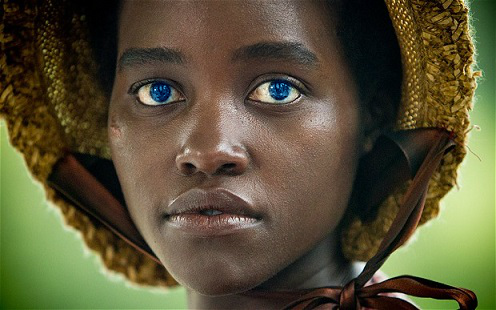
Saving Pecola Breedlove With Lupita Nyong’o

Photo Enhanced by OurLegaci

It isn’t enough to say that “Black Girls Rock.” It isn’t enough to proclaim that “Black is beautiful.” These proclamations bear a certain level of importance but what good is it to say these things if too often our collective actions show otherwise? Show Black girls how beautiful they are, how worthy they are, how valuable they are by fighting for them.

As the world becomes enthralled with the talent and beauty of Lupita Nyong’o, she continues to spread her message about the power of self love in the face of colorism. Images of her versatile beauty have taken over the internet in a display of glorious artistic prowess. Consequently, there are a myriad of discussions about the effects of Lupita’s spotlight on the millions of women and girls that look like her.

Yes, her beauty is sure to inspire, much like she was inspired by Alek Wek. But let this moment of adoration, along with Lupita’s openness to reveal her own struggles, lead to something beyond admiring beauty. If we truly want young Black girls to get the message that they are both valuable and beautiful, we have to show them by fighting for them.

lupita-fashionsizzle

Lupita Nyong’o accepted her Oscar while honoring the spirit of Patsey, the enslaved and brutally abused woman she embodied in her award winning performance. Many viewers of 12 Years of Slave wanted desperately for Patsey to be freed from her abusers. We saw the beauty in Patsey. We knew that she was worth fighting for…worth protecting. We can’t go back in time, but we can work to make sure that Patsey’s daughters don’t live a life of congratulated pain.

Abuse happens to girls of all races, ethnicities and cultural backgrounds. But when it comes to Black girls, the mechanism of race allegiance and the need to project race respectability often supersedes their need for protection. This leads to families keeping “secrets,” parents refusing to press charges, and neglect reigning supreme under the guise of keeping the peace. The ever present victim blaming then commences by calling the girl “fast” or asking, “Why was she over there if she didn’t want it?” And let us not forget the, “She knew what she was doing,” declaration. In an instant, a 14 year old girl becomes the sacrificial lamb of the Black community in addition to facing marginalization in mainstream society.

And you wonder why a girl could have color issues, wish for blue eyes or blonde hair. It’s not necessarily because she hates herself. It’s because she wants to be what she believes the world is more likely to adore and protect.
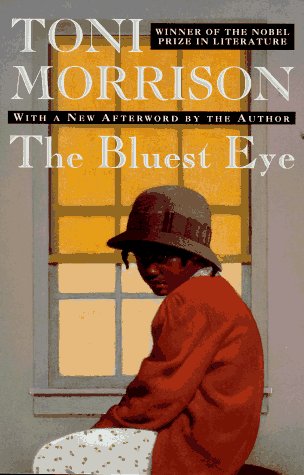
the-bluest-eyePecola Breedlove is a character in Toni Morrison’s first novel, The Bluest Eye. Pecola endured rape, neglect and various forms of abuse. She was a little Black girl, undervalued and unprotected, that wished for blue eyes.

Fighting for “her” involves building a fortress around her being. Not allowing abusers and neglecters  to have their way with “her” life. On a personal level, I know many Black woman that were sexually assaulted and abused as young girls. Their stories never made it to the news. Their abusers have gone free and the scars reflecting the pain are permanently etched in memory. They’ve all heard “Black is beautiful,” but nobody fight for them. Instead, they were blamed for their own abuse, shunned and rejected.

When you see a potential Pecola Breedlove, it’s not enough to show her pictures of Lupita to prove the existence of her beauty. We first have to protect her…show her how much she means us. We can let her know that she is not an “ugly ducking” but in fact a beautiful swan by showing her Lupita’s talent and beauty. But it is only after we protect her, that she will be able to believe and absorb this truth.

JamAllen2-nb-smallJessica Ann Mitchell is the founder of OurLegaci.com & BlackBloggersConnect.com. To reach JAM, email her at OurLegaci@gmail.com.

Follow OurLegaci on Facebook at Facebook.com/OurLegaci.
Walmart The Welfare Queen

Photo Credit: Amazon

Perhaps Walmart executives should hold a private viewing of the Lion King to learn about the Circle Of Life. After fighting tooth and nail against living wages for employees and working with ALEC, Walmart’s own selfishness is catching up with them. As one of the largest corporations on the planet, Walmart execs work tirelessly to prevent its underpaid employees from getting higher wages and health insurance benefits. Walmart now faces a 21% loss in its fourth quarter and it’s blaming the expiration of food stamp benefits.

On Thursday Wal-Mart reported a 21 percent decline in its fourth-quarter profit. The company said that the Nov. 1 expiration of a temporary boost in food stamps is hurting its shoppers’ ability to spend. It’s also caught up in the debate about minimum wages and dealing with increasing competition from dollar stores and grocers. – MSN Money

iStock_000002486895XSmall

Walmart has plans underway to open up 6 stores in Washington, DC and threatened to pull out if the DC Council approved a new living wage bill. The council approved it anyway but not surprisingly the bill was vetoed by D.C. Mayor Vincent Gray in an attempt to keep peace with Walmart.

Mike Debonis of the Washington Post states,”The city’s minimum wage is $8.25 an hour. The bill would raise the annual earnings of a full-time employee making the lowest legal wage from about $17,000 to $26,000.”  It should be noted that $26,000 is just above the Federal Poverty Line for a family of four. At a pay rate much lower than this with limited hours, it’s easy to understand why one Walmart store hosted food donation drives for it’s own employees.

Walmart’s new 21% loss means that in addition to the government subsidizing Walmart’s low wages by providing its employees with food stamps, the government is also a prime provider of funds to Walmart through its customers. Meaning that Walmart depends on food stamp recipients as a key consumer base. Now that those benefits are ending Walmart is in a crunch. Perhaps if they spent more time making sure that their employees could survive without needing food-banks, they would understand that pushing for legislation against the working class is not only unethical but harmful for business. People go to work, get paid and buy things. If they don’t have even money for basic needs like food, potential consumers are not going shopping. Walmart is a prime example of how “job creator” initiatives are hurting the economy. Suddenly Walmart is considering a new found support of Federal minimum wage increase.

Bloomberg.com reports, “David Tovar, a company spokesman, said today in a telephone interview. Increasing the minimum wage means that some of the 140 million people who shop at the chain weekly would “now have additional income.”

I guess they’re finally learning how this works.  The next time a conservative drones on about “entitlements” and poor people bashing, remind them that Walmart survives on food stamps, tax write offs and subsidies. They’re one of the biggest Welfare Queens in the land.

JamAllen2-nb-smallJessica Ann Mitchell is the founder of OurLegaci.com & BlackBloggersConnect.com. To reach JAM, email her at OurLegaci@gmail.com.

Follow OurLegaci on Facebook at Facebook.com/OurLegaci.

Fairy Tales of Reverse Racism Race Baiters

reverse-racism-450

It’s really disturbing when injustices that are linked to racism are brushed aside and we’re called race baiters for bringing it up. As if I’m imagining things. As if I created race. As if being silent is going to make everything okay. And the coup de grâce is that some unfortunate souls actually believe that by pointing out racism, that makes someone a racist. I find this to be a signifier of the failure of the education system. So many people know how to throw around the term, but so few know what it really means.

For everyone that’s confused, racism is a historically rooted systematic structure based on the creation of racial hierarchies. It’s racially based prejudices reinforced by systematic power structures that design global economic disparities, social guidelines for imprisonment, medical apartheid, and the socially determined value of life.

Just being born a Black woman in this current state of affairs, I simply do not have the structural power or capacity to be racist. And if it’s hard for you to grasp this information from me, please do Ask The White Guy and this really cool Bangladeshi Australian guy who gets it:

Still, I don’t deny that as an African American woman in the current world, I am born with a certain level of privileges that my ancestors didn’t have. For one, I wouldn’t be writing on this blog because it would have been unlawful for me to read or write. I wouldn’t have gotten two master’s degrees (that I’ve been told Affirmative Action paid for) because that too is a punishable offense. For being an uppity negro wench, I would have been hanged and buried in some unknown location and it would have been deemed justified because I didn’t know my place. That fact is the disturbing root of this discussion. These seemingly innocent demands of my silencing are born out of that same legacy. These are “be quiet or we’ll reprimand you” statements. 

Instead of trying to silence discourse, just admit that you’re a coward. Just admit that comfort and dare I say privilege is more important to you than justice. No we can’t talk about the prison system, the fall of the middle class or the military industrial complex without race. No, no, no! To exclude race from these topics is to participate in the erasure of reality and to disregard the validity of millions of lived experiences. These “reverse racism” and “race-baiter” accusations are built on nothing more than modern day fairy tales.

The racial divide is real:

Unequal prison sentencing: Check
Exclusion from the workforce: Check
Sexual abuse: Check
Segregated education: Check
Insufficient medical attention: Check

Pointing out all of these issues is not divisive, but ignoring them is.  It prevents us from fully exploring and understanding the crux of the problem. You’re not really for social justice if work ends when you feel uncomfortable. Perhaps you should ask yourself why your comfort is so dependent on avoiding the deconstruction of racism. If you’re not ready to have this discussion just admit that and move on. Remove your activist, social justice title and just “get to steppin.” But don’t try to silence people because you feel uncomfortable.  Those times are long gone. Mammy retired, leaving us very detailed instructions…being quiet is not on the list.

– Join My Mailing List –

I’m A Single Parent And I’m Not Responsible

Single Mothers

As a single parent, there is nothing I hate more than someone saying,

“Is his father around?  Did you know he was an asshole before you got pregnant?”

As if I am responsible for him being a ‘deadbeat dad.’  Yes, I am partially responsible for him being a dad.  He is solely responsible for him being a deadbeat.

Now, let me say that I completely understand why someone would ask that but know this:  Our relationship, good or bad, before having our son does not absolve him from being a good father.  Nor does that make me responsible for him being a bad father.

I raise my son alone.  I have a great support system in my family and my son’s paternal family.  I clothe him, feed him, care for him, protect him and love him AS I SHOULD.  I am taking responsibility for my actions and choices. I’m doing what I am supposed to be doing as a mother.  Being irresponsible led to my being a mother.  It also led to me making the responsible choice of taking care of my son.

That there is where the responsibility rope ends for me.  I AM NOT responsible for his father not being present.  I am not responsible for his father choosing to not be a parent.  When a person tells a woman, “well, you should have known….” you are taking the responsibility away from the man and placing it on the woman.  You are telling her, “it is your fault that your child’s father is not around.”  I now know that not to be true.

For a long time I beat myself up thinking that it was my fault that my son is growing up without his father. It took me a while to realize that I was blaming myself for something of which I have absolutely no control.  Once my son was born all of the shoulda, coulda, woulda’s became irrelevant.  I couldn’t go back and change anything.   All I could do was be the best mother possible.  And that’s what I’m doing.

We both chose to engage in irresponsible sex and our son is the outcome.  However, I am taking responsibility for my actions.  I refuse to take responsibility for his inactions, also.

Destyne-MillerDestyne is a single mother and educator. Through personal experiences and life lessons she hopes to bring a different perspective to everyday issues in a simple, straightforward, yet positive way.  With her free spirit and ever evolving thought process she takes on the challenge of bringing people together.  Not to make them think the same but to be able to exist as different and unique individuals. Visit her blog Destynefulfilled.wordpress.com.

Source

A Man With No Land

iStock_000006274328Small-2

Today at work I sat discussing heritage with three of my coworkers: a Haitian African, a Jamaican and a Dominican. They all conversed about revolutions, events and people from their homelands who are stapled into their histories. They spoke with such pride because various people and situations have helped to shape their people’s identity and culture. Whatever happened on their land happened in their history. I sat a bit envious, for though they are like African Americans in which most of them were brought to their respected lands; they and their lands are one.  They are tied to their old-new homes. They love it, and it claims them. These thoughts led me to ponder what land do African Americans associate themselves with? And what land claims the African American? From my experience, it is clear that African Americans are not deeply connected to any land.

When I consider each of my coworkers land heritage, I am troubled with my lack thereof. In African American history we have many heroes who have, on American soil, fought for us, descendants of slaves, to attain many freedoms. In a land where we were brought to as slaves, we now have rights, liberties and representation in the highest office in the free world. But does America really claim the African American as his brother, or are we simply overstayed visitors? From slavery to lynching and the countless murders of minorities throughout the years among other things, I presume that the land of the free hasn’t truly accepted the free slave. When so many injustices are allowed against us, it’s hard to feel like America is really our home. Well, I know that’s how I feel. So, if America seems unsure of our kinship, where do we call home? Where are we connected to?

At times, it seems like nowhere.

Both my parents are from the south and came north to escape the tumultuous south of the 50’s. My mother was born in Savannah Georgia, and my dad was born in Lee South Carolina. Neither of them, nor I, have ever traveled outside of the country. We don’t go visit cousin so and so in Nigeria. When we go visit family, we go down south. When West Indians or Africans ask me where my family is from, I often say the south because I have no other point of reference. I was born and raised in the New York; I have no connection to the south or Africa. I tried reconnecting with my family from the south, and as pleasant it was it left more questions. Who are we really as a family? Where are we from? I learned that one of my great grandfathers was a musician and that excited me. I felt a sense of rootedness.

I realized that I wasn’t an island, but that men who came before me excelled in similar ways and shared similar pains. Still, questions like where certain relatives got specific strengths haunt me. Not having a home land that is filled with my people, my heritage and my culture leaves me a bit misguided about who I am. It also concerns me of who we are as black men and women. Does our legacy end with jazz and the civil rights and a certain black vernacular? Or is there more? Though my parents are from the south, we are so much more than southerners. My parents themselves do not claim to be from anywhere else but the south. They have, like many of our parents and people, no connection with who they really are and where they really from: Africans from Africa.

Many attempts have been and are being made to mend the lack of identity and culture that resulted from slavery. Kwanzaa, created by an activist and scholar named Maulana Karenga, was conceived to give Afro-Americans their own holiday: a sense spiritually individuality. The Pan-American Flag was crafted with a similar intent: to give us culture and identity. With all these attempts, the thirst for a home hasn’t been quenched within blacks. Recently, many celebrities have begun to participate in DNA analysis that traces back ones genealogy. African American Lives, hosted and narrated by Henry Louis Gates Jr that premiered on PBS in February of 2006, is an example of this. It is a documentary that explores the history of men like T D Jakes, Chris Tucker, and Dr. Ben Carson as well as women like Oprah Winfrey, Whoopi Goldberg, and Dr. Mae Jemison through genealogical research. It married these Africa Americans to various countries and tribes in Africa which us remarkable.

Unfortunately, this isn’t the norm. Most blacks, if not in financial constraints, are at least misinformed about their access to such options. Many black men like me live either in the state of creation or in a state of assimilation. We either try to create an identity and culture for ourselves or we simply put on the American self. We align ourselves with American values, belief systems and ambitions ignoring any connection or reflection to our damaged past. We are a people whose culture continuously changes, for we have no foundation. Land-heritage brings foundation.

Going back to live in Africa can prove to be problematic, for we have no trusted relatives there.  However, finding out where our families originate from, give each of us a better context than what many of us have as African Americans. We are able to associate with outstanding music, attire, and spiritual practices that outdate our Kwanzaa, jazz, hip-hop, pan African flag creations. It is not a matter of better or worse but context. I believe saying to be extremely true: “you don’t know where you’re going, unless you know where you come from.”

On February 6, 2008, African Ancestry posted a video on YouTube of Judge Hatchett discovering her roots and she told this story while speaking to a young man:

I went to Africa with my sons last summer. And there was a Massai warrior who’s a little bit older than you are. And he said ‘where are you from?” And I said, naively, I said I’m from the United States. He said ‘nah nah nah nah nah no! Where are you from my sister?” And I didn’t know. And so when you got tested I got tested, so you have my results which I have not said I have been dying for this to come back today so I can have my result because never ever do I want to say again I don’t know.

Ask African Americans where they are from, and they will tell you some state or county, but the truth is most of our answers are like Judge Hatchett’s: we don’t know.

For black history month, I want my African descendant brothers and sisters to consider going home. Consider investing in these DNA genealogical tests because with land-heritage comes a stable culture and identity and most importantly wholeness which our people so desperately lack. Imagine finding out that your people are from Morocco, Egypt, Kenya, Namibia, Cameroon or Liberia, not from Savannah Georgia or Boston or Mississippi but Africa. Wouldn’t that be something? One real way that we can begin to rid ourselves from the evils of slavery is by reconnecting. It is by going back home. With the new advancements in science we can at least know where to start. It’s better to be a man a long way from home than a man with no land.

corey-spencerC. Lionel Spencer is a New York resident and writer, who is devoted to using his talent of writing to move our world community forward.

Behold, The All American Girl

All-American-Girl

I knew it. The moment I saw Coca Cola’s Super Bowl ad, I knew there was going to be turmoil. As soon as I heard “America The Beautiful” in Spanish followed by other languages, I knew the racist, prejudiced, bigoted uproar was coming. For so long, America has lived under an unrealistic idealized expectation of “true” Americanism. It is often supported in every day speech like, “All American Girl” and “Hometown Boy.” When we hear “All American Girl,” what immediately comes to mind is a thin, blonde haired, blue-eyed woman. However, those are mainstreamed ideals of exclusion, in which people that don’t possess this look are othered and marginalized. Coca Cola as a corporation can be critiqued for many issues. However their latest commercial has added to an important discussion about who is truly American.

The truth is a girl wearing her hijab and speaking Arabic is an “All American Girl.” A young woman speaking Spanish and shopping in a bodega is an “All American Girl.” A woman speaking Igbo at church is “All American.” A “Hometown Boy” may easily speak Korean as a first language.  This is America and to think otherwise is to delude one’s self. Our identity as Americans is not preluded by a certain ethnicity, dress code or way of speaking. Additionally, critics of the commercial believe that English is the only language for America, forgetting that American English is highly influenced by a litany of cultures and languages.

Perhaps this all stems from fear. The fact it is, America is browning. According to the Census Bureau,  “50.4 percent of our nation’s population younger than age 1 were minorities as of July 1, 2011. This is up from 49.5 percent from the 2010 Census taken April 1, 2010.”

The Associated Press reported, “The government also projects that in five years, minorities will make up more than half of children under 18. Not long after, the total U.S. white population will begin an inexorable decline in absolute numbers, due to aging baby boomers.”

They go on to state:

As a whole, the nonwhite population increased by 1.9 percent to 116 million, or 37 percent of the U.S. The fastest percentage growth is among multiracial Americans, followed by Asians and Hispanics. Non-Hispanic whites make up 63 percent of the U.S.; Hispanics, 17 percent; blacks, 12.3 percent; Asians, 5 percent; and multiracial Americans, 2.4 percent.

America is getting browner everyday and this fact paralyzes some people, especially those who have become accustomed to Eurocentric ideals of Americanism. The fear of the “other” drives voter suppression laws, the prison industrial complex and racial profiling. These are enacted to prevent marginalized Americans from having full access to the benefits of citizenship.

Regardless of where the hatred stems from, “America The Beautiful” only holds true to its name if we recognize the beauty in all of America’s citizens, not just the ones that have been mainstreamed or appear to represent the dominant culture. When Langston Hughes penned those prophetic words, “I Too Am America”, he was putting America on notice. You can deal with it now or you can accept it later but I too am American. And I’m not going away.

JamAllen2-nb-smallJessica Ann Mitchell is the founder of OurLegaci.com & BlackBloggersConnect.com. To reach JAM, email her at OurLegaci@gmail.com.

Follow OurLegaci on Facebook at Facebook.com/OurLegaci.

The Unreal History Of American Horror Story

Many are calling Season 3 of the hit FX series American Horror Story the best season ever. Though I enjoyed watching this season, we need to clear some things up concerning the show’s intertwining of historical events and figures associated with Black history.

Gabourey Sidibe as Queenie. Photo Credit: Michele K. Short/FX WeLoveSoaps.net
Gabourey Sidibe as Queenie. Photo Credit: Michele K. Short/FX
WeLoveSoaps.net

Queenie’s character, played by Gabourey Sidibe, is descended from a real person named Tituba. During the Salem Witch Trials, Tituba was accused of being a witch and beaten until she confessed. However, she was never put on trial and did not face execution. There is a historical debate waging about her ethnicity. However, most historians believe she was most likely Indian or mixed-raced with African ancestry. According to historian Benjamin C. Ray, two enslaved Black women, Mary Black and Candy, were also accused of witch craft during the Salem Witch Trials. Eventually charges against Mary Black were dropped and she returned home. Candy was also found not guilty.

Photo Credit: http://tenplay.com.au/
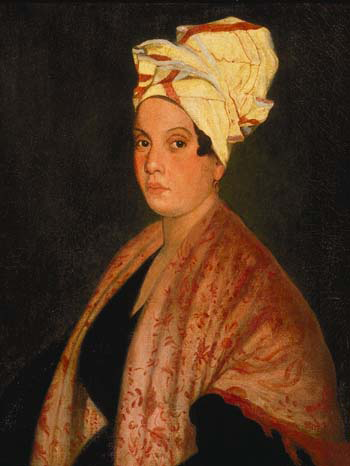
MarieLaveau_(Frank_Schneider)
Marie Laveau

Marie Laveau, played by Angela Bassett, is a historical figure, turned into a fictional character on AHS. Marie Laveau was born in 1794 and was known for her powerful practice of Vodou . Though depicted in the show as childless (except for the one child she gave to Papa Legba), she was in fact married twice and the mother of 15 children. She even had a “junior” daughter called Marie Laveau II. According to historical accounts, Marie was loved and feared by many for her gift of foresight. She knew many secrets and was often called upon to testify in trials. She mostly kept quite, but if the defendants were mean people, she would tell all of their dirty laundry and shame their families. Though she was commonly known as the “Voudou Queen”, she was also an avid church goer who brought many people into the church fold.

The New York Times published an obituary of Marie Laveau in 1881 stating, “Marie Laveau, one of the most wonderful women who ever lived, passed peaceably away.”

It goes on to say, “Marie had a large, warm heart and tender nature, and never refused a summons from the suffering, no matter how deadly the disease. Where ever she went, she labored faithfully and earned lifelong friends. During yellow fever and cholera epidemics, she proved herself a noble, disinterested woman, going from patient to patient, administering the wants of each and saving many from death.” – NY Times  1881 Archives

Photo Credit: WeGotThisCovered.com
Photo Credit: Afrik.com
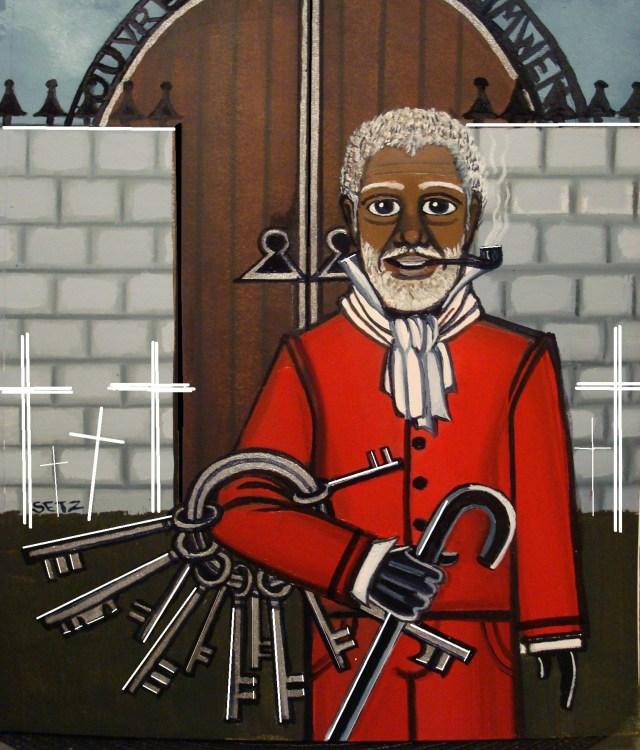
An illustration of Papa Legba. Photo Credit: Afrik.com

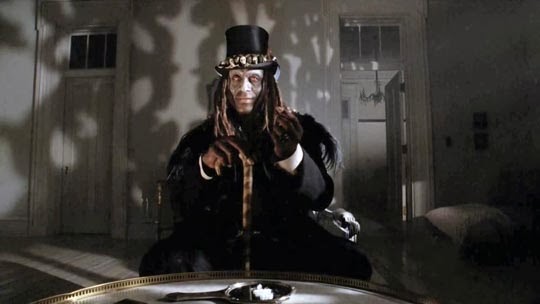
Unfortunately, for many viewers their first introduction to Papa Legba was as some sort of boogeyman figure that takes innocent babies and snorts cocaine. It has drawn much warranted criticism, because demonizing African  religions appears to be a re-occurring theme in Hollywood.

Papa Legba, played by  Lance Reddick, is an important spirit or Lwa in Vodou. According to historian Leslie G. Desmangles, “Legba is the patron of the universe, the link between the Godhead and the universe, the umbilical cord that connects the universe to its origin.” Desmangles also states,  “In his function as the guardian of universal and individual destiny, Legba is of Yoruba origin…'” Vodou spirits are derived from West Africa and are often associated with Catholic Saints. Thus to some, Papa Legba is also known as Saint Peter. However at times, Legba assumes a trickster persona called, Kafou. Still Kafou is viewed as an “inversion of Legba.” Devotees sacrifice roosters and chickens to Legba.

The word Vodou means spirit. Vodou is derived from West African Vodun practiced in Ghana, Nigeria, Benin and among various ethnic groups across the western coast of Africa. American cinema has done a wonderful job of mainstreaming the fear of Black-ness and African derived religions. Due to this fear-mongering, many people, including African descendants have become afraid of or disconnected from traditional or indigenous religions. Traditional or African derived religions have been practiced for thousands of years. During slavery and colonization, Africans and African descendants were punished for practicing their own religions, which at times led to a disconnect in understanding these religions among future generations. Vodun, like other religious practices has its benefits and disadvantages. But it is not inherently spooky or evil, these types of depictions are concoctions of the Eurocentric dehumanization of Black culture.

While many African descendants may lack historical knowledge of traditional religions, many of their religious practices in Abrahamic religions are still derived from traditional practices. This includes but is not limited to: call and response, the use of drums, repetitive lyrics, songs like “steal away” that include alternative meanings, ring shouting, and “speaking” things into existence. These are all African traditions that deserve a more nuanced understanding.

kathy-bates-american-horror-story
Photo Credit: Renegade Cinema
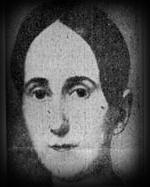
Delphine Lalaurie
Delphine Lalaurie

Marie Delphine LaLaurie, played by Kathy Bates was a real life serial killer in New Orleans. For years, she brutally tortured, maimed, and killed slaves. Her sick actions were discovered in 1834 during a house fire. Contrary to what AHS depicts, LaLaurie was born and raised in New Orleans and her family is of Irish descent. She was famous for hosting parties and entertaining guests. Delphine LaLaurie may have known Marie Laveau, who lived in her neighborhood. When LaLaurie’s evil acts were discovered, she and her daughters were chased out of New Orleans by an angry mob. Some believe they changed their names and fled to France.

The New Orleans Bee covered the story in 1834:

Upon entering one of the apartments, the most appalling spectacle met their eyes. Seven slaves more or less horribly mutilated were seen suspended by the neck, with their limbs apparently stretched and torn from one extremity to the other. Language is powerless and inadequate to give a proper conception of the horror which a scene like this must have inspired. We shall not attempt it, but leave it rather to the reader’s imagination to picture what it was.

These slaves were the property of the demon, in the shape of a woman whom we mentioned in the beginning of this article. They had been confined by her for several months in the situation from which they had thus providentially been rescued and had been merely kept in existence to prolong their suffering and to make them taste all that the most refined cruelty could inflict.

I’m glad that American Horror Story writers included these historical events and figures in their story line. Though their depiction is wrought with Hollywood spin and the same “old fear of Blackness” approach, more people are asking questions about these figures and opening up discussions about what is fact or fiction.

JamAllen2-nb-smallJessica Ann Mitchell is the founder of OurLegaci.com & BlackBloggersConnect.com. To reach JAM, email her at OurLegaci@gmail.com.

Follow OurLegaci on Facebook at Facebook.com/OurLegaci.
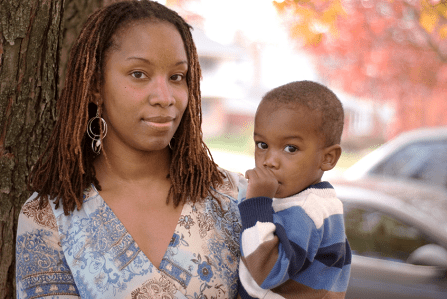
A Cure For The N-Word

At only 7 days old, a baby was called “N–ga” for the first time. I witnessed it as I visited a friend that had just given birth. The father of the new baby boy held him in his arms, smiled and said “This is my little n—a.” In my knee jerk reaction I blurted out, “He’s only been here for a week and you’re already calling him that!” The new father then corrected himself and said, “Oh, I mean he’s my little man.”

I knew what he meant. When he said that word, he was genuinely thinking loving thoughts towards his new son. Perhaps, that’s why I was so disturbed by it. His expression of love was laced with derogatory language of habit. A father has love for his first child and he articulates it by using the word N–ga.

————————————————————————————————————————————————————–

Black people saying the N-word is not the most surprising or troubling attribute of American lingo.  This is not a “Black” problem. To believe so, only further contributes to criminalizing the Black experience. The English language is ripe with coding, words and terminology that dehumanizes the “other.” Martin Luther King once stated, “Somebody told a lie one day. They couched it in language. They made everything black ugly and evil. Look in your dictionary and see the synonyms for the word black. It’s always something degrading, low, and sinister.” We are not the problem, our environment is.

Much like other modes of oppression, the N-word was used against us, to the point that some of us have become accustomed to and often perpetuate it ourselves. Almost without a choice, it becomes a stamped phrase lingering in our minds.

The phrase “My n- -ga.” is more complex than it seems. When it’s used within the African American community, it signifies a recognition of a shared experience. It’s almost like an inside joke or inner laughter is taking place towards the dehumanization. It’s like laughing to keep from crying while at the same time saying, “But I’m still here.” Within this seemingly unrecognized state of despotism, we’re surviving. Which is why for some, the song “N–gas in Paris” is triumphant. I’m not advocating for the usage of the N-word. I’m just saying, I understand. And this is what I believe many people are trying to articulate, when they say they’ve taken the word back.

This is why when perceived outsiders like Paula Deen, Madonna or John Mayer say the N-word, it’s automatically rejected. This is not done in some vacuum of hypocrisy but instead out of an often unspoken understanding that these people, do not share the lived experience of being boxed into the “n–ga” identity by main stream society. Therefore any attempts to interject within this subjugated space is viewed as appropriation or as a mechanism to further exacerbate their subjugated existence.

But how do we stop people from using it? It’s almost impossible to forcefully erase a term from common language. If people continue to identify with it, rather misguided or not, it will still be used. However, much of our concerns could be solved if we use our own legacy as a guide.” There are words much more powerful than the N-word will ever be. One of them is called Sankofa.  It’s a West African term that means “go back and fetch it.” Sankofa is often symbolized as a bird reaching back carrying an egg.The word and symbol serves as a reminder to use your historical compass to find your freedom. It’s like following the North Star.

Another word is Ubuntu. According to Archbishop Desmond Tutu, Ubuntu is  a South African term meaning, “I am because you are.” It reminds us that the humanity of one person is dependent on the humanity of others. We are all interconnected.

I’ve used these words and ideals on students before and noticed a considerable difference in attitude. My 3rd grade students, went from calling each other names to reading Langston Hughes’ “I Too Am America.” So has activist, Jarrett Mathis, who launched a full campaign on educating youth about African American history. I’ve found that once people, especially children know their history…their real history, they are less likely to think of themselves within the confines of the N-word or any other oppressive language. Their world becomes greater and expanded by the thought that finally, they can be something more than a “N–ga.”

So the next time, you hear someone call themselves by this term, try not to engage in respectability politics. Because simply being “respectable” won’t save us and never has. Instead, if the person is open to it, use it as a learning moment. Find some type of way to remind this person, who they really are. Even if they reject it initially, at least the seed will be planted.

“When n–gas become Gods, walls come tumbling.” – Erykah Badu

JamAllen2-nb-smallJessica Ann Mitchell is the founder of OurLegaci.com & BlackBloggersConnect.com. To reach JAM, email her at OurLegaci@gmail.com.

Follow OurLegaci on Facebook at Facebook.com/OurLegaci.

Why I’m Celebrating Ella Baker On MLK Day

Ella-Baker

Known as the “God Mother of the SNCC” Ella Baker was a community activist in the truest sense of the term. This is not to discredit, the courageous works of Dr. Martin Luther King Jr. but Ella Baker told us the dangers of leader driven movements…and she was right.

After years of working with the NAACP, Ella Baker became a key organizer for the Southern Christian Leadership Council, founded in part by Martin Luther King Jr. in 1957. She worked behind the scenes organizing voter registration campaigns, conferences and initiatives. Perhaps, she is most celebrated for recognizing the power in collective youth movements. The Student Non-Violent Coordinating Committee was formed under her guidance and launched a movement that changed the American political landscape forever. SNCC is widely known for organizing sit-ins and the 1961 Freedom Rides.

Baker’s greatest hope was that ordinary people see the power they hold within themselves. She famously stated, “Strong people don’t need strong leaders.” She cautioned against people relying on leaders, instead wanting ordinary people to take an active role in movements collectively and equally. And because of her defiance against “the messiah complex” Ella is perhaps a more dangerous figure than King for the status quo. This is because she fully represents a “Participatory Democracy”, in which people think for themselves, organize and bring about change (without the need of a leader). These types of movements are harder to stamp out.

In a leader motivated movement, once a leader is discredited, removed or assassinated, their movement struggles to regain its influence. A prime example of this was Dr. King’s Poor People’s Campaign that struggled immensely after his death.

Some ask if there will ever be another MLK. The answer is no and stop waiting on one. The true work comes in when people are able to mobilize without the need of charismatic leadership. As we celebrate the life of Dr. Martin Luther King Jr., let us remember a key lesson from the Civil Rights Movement. Everyone has a role to play and it starts with you. This was the heart of Ella Baker’s message.

Learn more about Ella Jo Baker.

JamAllen2-nb-smallJessica Ann Mitchell is the founder of OurLegaci.com & BlackBloggersConnect.com. To reach JAM, email her at OurLegaci@gmail.com.

Follow OurLegaci on Facebook at Facebook.com/OurLegaci.

What Really Happens On Vacation

iStock_000014273887XSmall
Photo Credit: iStockPhoto

I will never forget the day I saw a grown man publicly groping and sloppily tongue kissing a young girl. She sat atop his lap as he and his friends consumed rounds of drinks and happily made sexual advances. I was researching climate change in villages neighboring Arusha, Tanzania. My roommates and I decided to have a night of fun by going to a dance club in the heart of Arusha. This was the first time I witnessed what residents of the area referred to as growing problem.

The Tanzanian Daily News recently reported that sex trafficking is getting worse in Tanzania stating, “Human traffickers exploit aggravating conditions of people of Third World countries where there are no employment opportunities and economical inequity, social discrimination, political instability and human rights abuses are widespread by promising a better life.”

Reporters, dignitaries, ambassadors and countless employees from around the world often come to Arusha because the International Criminal Tribunal for Rwanda is located there. While away from home, many American and European men take the opportunity to use their “first world” status to buy young girls, who are often sold into sex slavery or forced into it due to a severe economic pressures. These “professional” men do things they could never get away with in their home countries. They often contribute to the spread of HIV/AIDS and other sexually transmitted diseases. This is called Sex Tourism.

I witnessed something  similar in the Dominican Republic. A friend and I were on a beach when an old European man, wearing a speedo, was splashing around in the water with a young Dominican girl. He appeared to be in his late 60s and the girl looked no older than 16 years old. They walked hand in hand. Then he directed her to go out in the water and pose. He took out his camera and started taking erotic photos of her body. The man soon glanced in my direction and tried to take photos of me. My friend turned to cover me until we were out of his sight. In tourist locations of the developing world, the sexual exploitation of women and young girls is often open and pervasive.

The Dominican Republic started taking steps towards preventing sex trafficking in 2013. These steps include charges against anyone that forces someone into sex trafficking and 10-15 year sentences for people that “use the services of prostitutes.”

In 2004, the New York Times reported that the U.S. started pursuing Americans that committed sexual offenses in other countries. At that time, 25% of all sex tourists were reportedly from the United States. However, in Cambodia and Costa Rica, the percentage widens to “38% and 80%”.

The story of American billionaire Larry Hillblom sheds further light on how exploitative drivers of the sex tourism world can be. Reporter Bryan Burrough referred to Hillblom as a “glorified sex tourist.” Due to Hillblom’s extreme wealth, he was able to special request virgin “pubescent” farm girls from South East-Asia. Upon his death, four Asian children from 3 different countries were identified as his descendants. Yet, the total count of girls he impregnated is still unknown.

For many of us, vacations are the best time of our lives.  As Jamaica Kincaid highlights, we often leave our dreary offices to enjoy the sunshine and pillage the wonders of the developing world. We smile in every photo and buy hoards of souvenirs. Meanwhile predators openly flaunt their indiscretions, using their “first world” privileges to commit some of the most egregious crimes against humanity. For millions of young girls and boys, this is what really happens on vacation.

How you can help.

JamAllen2-nb-smallJessica Ann Mitchell is the founder of OurLegaci.com & BlackBloggersConnect.com. To reach JAM, email her at OurLegaci@gmail.com.

Follow OurLegaci on Facebook at Facebook.com/OurLegaci.