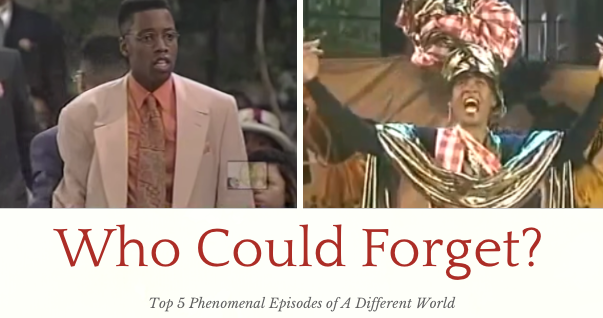
Top 5 Phenomenal A Different World Episodes

A-Differen-World-Episodes

As an 80’s baby, I grew up watching A Different World. I can honestly say that the show affected my life in a number of ways. It was the reason why I wanted to attend an HBCU. Consequently, I attended both Albany State University and The Fort Valley State University for undergrad. The first time I ever heard Nikki Giovanni’s “Ego Tripping” poem, was while watching an A Different World episode. I was just a kid but I still remember thinking to myself, “Wow I have to find this poem.” Did I mention, I’m also a poet?

The power of A Different World was its complete grounding in the African American experience. It was when Debbie Allen stepped at the beginning of the second season that the show really started molding towards this trajectory. A Different World started off as a Cosby Show spin off, following Denise to college and ended as a show with a massive following and fan base completely its own.

There are a slew of memorable episodes but here are my top 5.

1. The “A World Alike” episode aired in 1990, when I was five years old. I saw it a number of times as a re-run. It was one of the first times I heard African Americans speaking about what I would later come to understand as Pan-Africanism. The students at Hillman College were putting pressure on their school to divest from South Africa and cut off all connections with any companies that engaged in business with South Africa during the apartheid era. It was real life worldwide protests like this that supported South African freedom fighters and helped bring additional awareness about the horrors of apartheid in South Africa.

2. The “Mammy Dearest” episode aired in 1991. Kim, an aspiring doctor recounted how she was called “Mammy” as a child, after she dressed up as a queen. The pain of this stuck with her, as a young dark skinned Black girl. Meanwhile, Whitley struggled with the new found knowledge that her family had owned slaves. It was during this episode that Kim triumphantly performed Nikki Giovanni’s “Ego Tripping.” She shed the mammy stereotype and was re-crowned queen (I’m pretty sure I practiced this scene about 10 times. My favorite line was, “I turned myself into myself, and was Jesus.”

3. The “No Means No” episode aired in 1989. In this episode Dwayne learns that one of his friends is a rapist. His friend Garth bragged to him about forcing a girl to have sex. Garth says, “Once we got started, she started putting up a fuss. You know how they are. They wanna do it but they just can’t give it up. It’s our job to let them off the hook.” Dwayne then realizes that his friend Freddie who has a date with Garth, is in danger. He rescues her right as Garth is trying to rape her. This episode does a great job of defining rape with its mantra, “No means no!” There is no confusion or excuses.

4. The “Love Taps” episode aired in 1992. In this episode Gina attempts to hide her abusive relationship with Dion, a local rapper. With black-eyes and bruises, Gina is caught in the cycle of abuse and is unsure how to escape. Her friend Lena tries to help her but she is too ashamed to accept assistance. Once the rumor spreads about her painful truth everything unveils and her circle of friends comes to support and protect her. This is what needs to happen in real life. So many Black women are in abusive relationships and not enough receive the support that is needed in order to break away from them. The episode also touches on the recursive nature of abuse. Dion recounts how his father beat his mother. In real life many abusers grow up in domestic violence environments and grow up to become perpetrators themselves. Most importantly this episodes shows Black women AND Black men coming to her defense.

5. “Save The Best For Last”, known to many at Whitley and Dwayne’s wedding episode is one of my absolute favorites. It aired in 1992. I don’t advocate someone storming into an ex-girlfriend’s wedding to confess their undying love and steal the bride. However, this episode showcases a powerful bond and love between two Black people that is not seen enough on television or anywhere in the media for that matter. I also rewound this scene a number of times.

Spread The Word. Share This Post!

JamAllen2-nb-smallJessica Ann Mitchell is the founder of OurLegaci.com & BlackBloggersConnect.com. To reach JAM, email her at OurLegaci@gmail.com. Follow Jessica @TweetingJAM.

Follow OurLegaci at Facebook.com/OurLegaci.

Did Anybody Care?


they-matter
Josefina Rivera, Agnes Adams, Sandra Lindsay, Jacqueline Askins, Deborah Dudley, Lisa Thomas


There were six of them, chained in the basement of a Philadelphia house. The police almost couldn’t believe what they were seeing. The horrors of what the women experienced were almost unbearable to hear. Their kidnapper, Gary Heidnik, chained them, enslaved them, raped them, starved them, murdered two of them and forced them to eat another human being (feeding the rest of the body to the dogs).

What did all of these young women have in common? They were young, black and brown girls from the lower echelon of society. They grew up poor, some of them were prostitutes, all of them perceived to be “unwanted.” Our America, hosted by Lisa Ling on the Oprah Winfrey Network, featured the stories of missing Black women and the now infamous Heidnik kidnapping case. A quick google search of his name will render headlines like “Heidnik’s House of Horrors.”

Indeed the women survived an unimaginable, terrifying ordeal. One of the survivors, named Jackie shared her experiences. She now suffers from Post Traumatic Stress Disorder and depression. Sometimes, she blacks out and unconsciously re-enacts being chained to the basement floor and eating dog food.

For months Jackie and 5 other women languished in a seemingly timeless agony, wondering if they would ever get their freedom.

When hearing about these types of stories, the blame is usually placed solely on the perpetrator. Yet, we need to realize that society plays a complacent role in allowing these types of crimes to occur. All too often perceived “respectability” trumps humanity. Lives are somehow worth less, or are less important if the victims did not lead “perfect” lives as dictated by societal norms. This is especially the case for young Black women, people living in poverty and for sex workers.

Jackie, being a symbol of this marginalized trifecta, was as they noted in the documentary, “lost before she was kidnapped.” As she lived on the margins of society, Heidnik presumed that no one would miss her. And for the most part he was right.

Jackie asked, “Did anybody care that we were out there? Just to call 911 and say, ‘she’s gone?’ Who cared about a Black prostitute, on drugs?”

So as four of the six women, survived until they were finally freed, time moved on without them. And as they finally regained their freedom, society gasped at the horrors they’d experienced, media focused on the perpetrator and in-depth discussions concerning why or how this truly could have happened in the first place, were passed over in the name of sensationalism.

Moreover, Jackie returned to a community that blamed her for being kidnapped and called her “the slave” and “the people-eater.” This severe lack of community support only exacerbated her fragile mental condition.

“She was a slut. She was a whore. She was high. She was drunk. She was in the streets. That’s what she gets. She shouldn’t have been [insert any excuse]. ” Whenever you hear someone say these things, whenever these words leave your mouth, know that these beliefs nurture the ambitions of abusers and murderers.

What she was, who she was, doesn’t negate her personhood. It didn’t negate her human right to live and be free.

There is a dispute over whether or not Gary Heidnik was sane while he was committing these unthinkable acts. His past medical records indicate that he may have been schizophrenic. But one thing is clear, Heidnik knew for certain where to find the perfect victims, the people that were would less likely to be protected or fought for. He chose the people that had already been used, abused and thrown away by society….poor, young, Black women.

That’s what really enabled this crime…a mass societal lack of care and he knew it.

I guess he wasn’t insane after all.


Learn more about this case:

http://www.oprah.com/own-our-america-lisa-ling/Jackie-Returns-to-the-House-Where-She-Was-Held-Captive

http://www.phillymag.com/articles/inside-the-house-of-heidnik/

Learn how to prevent events like this from happening:

http://blackandmissing.org/what-to-do-if-someone-goes-missing/

http://abcnews.go.com/blogs/headlines/2012/01/getting-more-to-care-about-missing-black-women/

Spread The Word. Share This Post!


IMG_0054-ZF-7906-35913-1-001-006Jessica Ann Mitchell is the founder of OurLegaci.com & BlackBloggersConnect.com. To reach JAM, email her at OurLegaci@gmail.com. Follow Jessica @TweetingJAM.

Follow OurLegaci at Facebook.com/OurLegaci.



How Innocent People Are Wrongfully Convicted

Wrongfully-Convicted-Of-Murder

“There is nothing funny about a Black man going to prison for something he didn’t do.” My excitement about watching the movie Life was quickly shut down when my mother stated those words. As a 14-year-old, I hadn’t looked at it that way before. Life, starring Eddie Murphy and Martin Lawrence, was a hit comedy about the antics of two Black men in Mississippi serving life in prison after being wrongfully convicted of murder. She refused to watch it.

The truthful sting of my mother’s response was fully warranted. Being wrongfully convicted of murder happens far more often than people think and can happen to anybody but especially to African Americans. And indeed, there is nothing funny about it.

Even as far back as 1996, the book “Convicted But Innocent: Wrongful Conviction and Public Policy” estimated that there was an output of at least 10,000 wrongful convictions a year. The abstract states, “Even if the American criminal justice system proved 99.5 percent accurate, it would still generate more than 10,000 wrongful convictions a year and these would reflect only serious index crimes.”

More recently the Innocence Project highlighted that studies find,”between 2.3% and 5% of all prisoners in the U.S. are innocent (for context, if just 1% of all prisoners are innocent, that would mean that more than 20,000 innocent people are in prison).”

According to a 2012 report by the National Registry of Exonerations about 2,000 people have been exonerated for wrongful convictions since 1989. Still, this number is in the least bit comforting. As the report notes:

…even 2,000 exonerations over 23 years is a tiny number in a country with 2.3 million people in prisons and jails. If that were the extent of the problem we would be encouraged by these numbers. But it’s not. These cases merely point to a much larger number of tragedies that we do not know about.

So how does this happen?

The Innocence Project lists the leading causes of false convictions as eye-witness misidentification, false confessions, improper forensic evidence and informants. One would think that these components would only lead to rightful convictions but each is severely flawed. For example, in 73% of convictions overturned with DNA, prosecutors used eye-witness accounts. But in many of these accounts there was “cross racial identification,” a known issue because studies show that it’s harder for witnesses to remember the facial details of people from other races.

False confessions are flawed due to pressures to accept plea deals and other coercion tactics. Informants are problematic sources because they are often offered plea deals and dropped charges in exchange for their testimony.

Dateline NBC recently featured a story about Eric Glisson, a man that was wrongfully convicted of murder and served over 17 years in prison. There was no physical evidence, only the words of one “eye-witness” and two other allegedly coerced witnesses. One of these witnesses recanted her testimony stating that she only testified due to police pressure of being threatened with jail time. It took 17 years, but Glisson and his co-defendants were finally freed. A total of five Black and Latino people (four men and one woman) had been in prison for almost two decades for a crime they didn’t commit.

Then there’s the story of The Central Park Five, who were recently awarded $40 million dollars after enduring 7-13 years in prison for a 1989 rape. In 2002, they were exonerated after a confession from the real perpetrator and DNA evidence proved their innocence. In another case, Jonathan Fleming was recently released after spending 24 years in prison for a Brooklyn, NY murder that was committed while he was in Florida.

There are many more stories like these that have yet to be concluded.

I recently learned of a case that hits closer to home. Jean Pierre DeVaughn is the older brother of a friend that I attended college with. Accused of murder-for-hire in the 2005 death of his cousin’s husband, Devaughn has maintained his innocence. He was convicted in 2011 and sentenced to life in prison with an additional 25 years. Having no prior record, he was offered a plea deal but refused to take it, wanting to fully clear his name.

His case is fraught with a series of issues. Devaughn endured an intense interrogation by police, during which a chair was thrown at him, he was taunted and his requests for a lawyer were denied. Additionally, there is no physical evidence linking him to the crime.

According to his defense attorney, a key witness in the first trial testified under the false pretense that Devaughn had accused him of being the murderer. Additionally, racial bias may have tainted jury selection leading to three African Americans being excluded from the jury.

In 2009, Rev. Jesse L. Jackson Sr. endorsed a letter written to the Fulton County District Attorney Office on Devaughn’s behalf. He is now represented by Janice L. Mathis, lawyer, activist and Vice President of the Rainbow PUSH Coalition Atlanta chapter.

Some may think it a bit presumptuous to believe that Devaughn is innocent, but history has shown us not to ignore pleas for a second look at trials that were once proclaimed to be “open and shut” cases. For now Devaughn waits in a Georgia prison for another chance to prove his freedom. The Supreme Court of Georgia will soon review his case.

Perhaps the most disturbing fact about these cases is this could happen to anyone and exonerations are rare occurrences. Many wrongful convictions include death row prisoners, which is all the more reason to support efforts to end the death penalty.

As an article from Scientific American highlighted, “Since 1973 144 death-sentenced defendants have been exonerated in the U.S. But Gross says that the analysis indicates that at least 340 people would have been put to death unjustly in that same time period.”

According to the Innocence Project, there have been only 316 post-conviction DNA exonorees, with 198 being African Americans. This is a daunting number considering African Americans only make up 13% of the US population. The numbers indicate that there is an overwhelming rate of bias concerning death sentencing for African Americans. Additionally, it’s hard to have many cases reviewed due to destroyed or lost evidence.

Something is devastatingly wrong here in the land of the “free,” especially considering the influence of corporate profits from the prison industrial complex. This is a real life horror story.

There is a perception that criminal convictions among African American youth are inherently just. But the fact is, many convictions stem from not having proper representation, not knowing the full scope of their rights when questioned by the police, being denied their rights and racially biased sentencing. An overwhelming amount of exonorees are Black men and women because an overwhelming amount of this demographic are wrongfully convicted or given harsher sentencing than their counterparts (sometimes even according to skin tone).

What can you do to prevent this from happening?

For now, it’s important to support initiatives like the Innocence Project and the Center on Wrongful Convictions that are doing the work to assist as many wrongfully convicted prisoners as possible. Push for your local jurisdiction to include preventative measures like recorded interrogations, proper and long-term preservation of forensic evidence, and advocating for eye-witness identification reform. 

Please do not republish this article without specific, written permission from Jessica Ann Mitchell.

IMG_0054-ZF-7906-35913-1-001-006Jessica Ann Mitchell is the founder of OurLegaci.com & BlackBloggersConnect.com. To reach JAM, email her at OurLegaci@gmail.com. Follow Jessica @TweetingJAM.

Follow OurLegaci at Facebook.com/OurLegaci.
How the death of my friend changed how I see this world

Victory Over Violence: How the death of my friend changed how I see this world

BlackWomanOutside

I still find it hard to wrap my mind around the fact that one of my friends isn’t alive anymore. I don’t like to say he was killed the way cancer or disease or car accidents kill the body. He didn’t just die like people do when they get older or have a heart attack or stroke. My friend was murdered. His life was taken from him by another life. My life-long friend Victor was shot and killed in a parking lot in Newport News, Virginia. He was only 23 years old and would’ve turned 24 just weeks after the shooting. He was a father and a friend. Now he is another nameless face on the list of victims of gun violence in my city and in this country.

VictorThere will be no marches in the street for Victor. His mother won’t be invited to the White House. The President isn’t going to cry on national television over his death. The world will never know the young man who always kept people laughing, who was always trying to have fun, and who had unconditional love for his young son. And the people who did know him will never know the man he could’ve grown to be. And its a shame, really. It’s a shame that violence like this is too common to make a big deal of it each time a person gets shot in the street.

When someone gets killed in this country, I think we get sad for a few minutes then eventually get on with our lives. I don’t want that to happen in Victor’s case. It’s so easy for us to turn a blind eye to all of the violence going on around us all of the time. The violence against young people in our communities, especially young people of color, is like a modern-day lynching. Just as crowds gathered around the bodies hanging from trees, today’s Americans stand idly by as our young people are slain in parking lots in Virginia, while walking home in Florida, in public parks in Chicago, and in elementary schools in Connecticut.

We are a nation in denial about what is happening in our front yards, right before our eyes. We legitimize this violence in the name of our Constitutional rights. But the issue of “gun control” is not a political issue, it is a moral one. No person who values life can value the usage of guns and weapons. A gun’s only function is to take life away. Despite what advocates for weapons may say, protecting someone’s right to bear arms is not more important that protecting the people’s right to life. But even with all of the horrific and bloody murders that take place in the country, we still can’t seem to put a face to the lost lives and protect those who are still living. But Victor’s face will always be in my mind.

At his wake, I held Victor’s mother and we cried while looking down at his face for the last time. But I keep thinking that he wasn’t the only life that was lost that night. While one mother has to bury her son, another mother will have her son put in jail for a senseless murder. That’s the life cycle of murder in our communities: One body goes in the ground, another body goes in a jail cell. Who wins in this scenario? We are living in a culture in which young men have a need to prove themselves to a society that tells them that “you aren’t a man” if you let yourself get punked. When someone steps on your shoe, looks at your girlfriend or boyfriend, posts on your Facebook page or what have you, we feel we have no choice but to react. There’s a hopelessness to this lifestyle. We get into arguments and allow our anger to escalate to the point when the only way to solve a problem is to end a life. So many self images are warped by false ideals of what it takes to be a “real man”.

Victor was a man. He was a loyal friend. He was a selfless father. He was one of the funniest, hyperactive, brutally honest people I’ve ever known. He was an athlete, a college graduate, and natural comedian. He tried to make a joke out of every stressful situation. He didn’t need to use violence or anger to get what he wanted out of life. I know there are others who aren’t able to see another way to live their lives without arguments, fighting, and guns. Funerals, drive-bys, and constant crime is the reality for too many of our young people. We’re exposed to violence which makes it easier for us to transcend into violent lifestyles ourselves. I’m sure in some cases, a gun seems like the only thing in life that you can use to escape the frustrating restrictions of life in our communities. We have unemployment, lack of interest in school, and such a comical ease in getting weapons, our young people turn to violence as a outlet for brief control in a society that automatically writes them off.

Victor was very young when he succumbed to his fate. He would have celebrated his 24th birthday just 5 weeks after the shooting that took his life. Although I’d like to think he’s still turning up at a birthday party somewhere in the universe, he is not here to celebrate with his friends and family who continue to mourn his loss. One bullet took away that birthday. Unfortunately, this is the fate that seems to awaits many young black men. Violence is not definitely not just a black issue, but it cannot be denied that violent crimes plague areas with high black populations like an incurable disease. According to the Center for Disease Control and Prevention, homicide is the leading cause of death for Black men ages 15-19. Is that shocking to anyone besides me?

Apparently not. Shortly after the news broke of another fatal shooting in Hampton Roads, my fellow citizens took to the Internet ready to criticize the victims in the shooting that took Victor’s life. Comments like: “not shocked by another murder on the Peninsula” … “I do wonder, how have you lived your life?” … “keep wanting to live like a gangsta you’re gonna die like one” made me want to cry. We blame others for having to live life in a violent depression instead of trying to find a solution. We don’t help the ex-offenders in our communities resimilate into society. We don’t press upon our children the doors that education can open for them. We shame our single mothers away from getting government assistance so their families turn to crime to provide for their basic needs. We suffer from an endless stream of disappointments that cause us to react violently in desperation.

I don’t pretend to be an expert on guns, life in “the ‘hood”, the Constitution, or even what really happened the night Victor lost his life. But I know we’ll never make progress if we keep allowing the lack of opportunities in our neighborhoods to make us to feel hopeless and worthless. That’s how we break this cycle and claim victory over violence: We reclaim the value of life. We show our young people all of the doors an education can open for them. We press upon others how much more courage it takes to be “weak” and to not react. We help others who need help, instead of making them feel ashamed. Jimmy Greene, father of 6 year old Ana Grace who was killed in the Sandy Hook shooting said it best: “we’re so consumed by the political fight…what about the fight for our children”. We are indeed in a fight for our lives. At the end of the day, our political standpoints won’t protect us. Our young people need to have a shot at a life filled with success, not a shot through the body with a bullet.

I see all of my friends and family posting to social media “Live4Vick”, “RIPVick”, “Gone but not forgotten” and the other typical mantras used to commemorate a lost life. But I sincerely hope we never forget Victor or the others wounded and killed by unnecessary violence in this country. I hope we do live our lives for these fallen souls and stop taking lives away. The best way I can honor Victors memory is to never forget what happened to him. We all can use our gifts to uplift the hopeless young man who sees a gun as the only way to control what goes on around him. We can control our emotions when we begin to get angry about little things. We can try to love instead.

I titled this piece “Victory over Violence” in memory of my friend Victor and also in the hope that one day this nation and people of color will rise above our tendencies to hurt one another. I know nothing we do will bring back the loved ones we’ve lost. But we should not allow ourselves or others to forget what happened to the ones we’ve lost. We have to really live for those who’ve died. We may never have a true victory over violence, but everyday we can make progress towards a more peaceful existence.


Jolie A. Doggett is a 22-year-old blogger from Hampton, VA currently living in the DC Metro Area. She received her bachelor’s degree in journalism from the University of Maryland, College Park in 2012. Since them, Jolie’s worked with Sirius XM Radio, National Public Radio, Patch.com, The National Congress of Black Women, and more.

Her musings on race, gender, and the 21st century have been featured on numerous blogs and websites, including her personal site, JolieDoggett.com. Her goal is to continue writing and to expand her social commentary into documentary film making. Her passions include Harry Potter, Chipotle, afro puffs, and volunteering in elementary schools.


A Cure For The N-Word

At only 7 days old, a baby was called “N–ga” for the first time. I witnessed it as I visited a friend that had just given birth. The father of the new baby boy held him in his arms, smiled and said “This is my little n—a.” In my knee jerk reaction I blurted out, “He’s only been here for a week and you’re already calling him that!” The new father then corrected himself and said, “Oh, I mean he’s my little man.”

I knew what he meant. When he said that word, he was genuinely thinking loving thoughts towards his new son. Perhaps, that’s why I was so disturbed by it. His expression of love was laced with derogatory language of habit. A father has love for his first child and he articulates it by using the word N–ga.

————————————————————————————————————————————————————–

Black people saying the N-word is not the most surprising or troubling attribute of American lingo.  This is not a “Black” problem. To believe so, only further contributes to criminalizing the Black experience. The English language is ripe with coding, words and terminology that dehumanizes the “other.” Martin Luther King once stated, “Somebody told a lie one day. They couched it in language. They made everything black ugly and evil. Look in your dictionary and see the synonyms for the word black. It’s always something degrading, low, and sinister.” We are not the problem, our environment is.

Much like other modes of oppression, the N-word was used against us, to the point that some of us have become accustomed to and often perpetuate it ourselves. Almost without a choice, it becomes a stamped phrase lingering in our minds.

The phrase “My n- -ga.” is more complex than it seems. When it’s used within the African American community, it signifies a recognition of a shared experience. It’s almost like an inside joke or inner laughter is taking place towards the dehumanization. It’s like laughing to keep from crying while at the same time saying, “But I’m still here.” Within this seemingly unrecognized state of despotism, we’re surviving. Which is why for some, the song “N–gas in Paris” is triumphant. I’m not advocating for the usage of the N-word. I’m just saying, I understand. And this is what I believe many people are trying to articulate, when they say they’ve taken the word back.

This is why when perceived outsiders like Paula Deen, Madonna or John Mayer say the N-word, it’s automatically rejected. This is not done in some vacuum of hypocrisy but instead out of an often unspoken understanding that these people, do not share the lived experience of being boxed into the “n–ga” identity by main stream society. Therefore any attempts to interject within this subjugated space is viewed as appropriation or as a mechanism to further exacerbate their subjugated existence.

But how do we stop people from using it? It’s almost impossible to forcefully erase a term from common language. If people continue to identify with it, rather misguided or not, it will still be used. However, much of our concerns could be solved if we use our own legacy as a guide.” There are words much more powerful than the N-word will ever be. One of them is called Sankofa.  It’s a West African term that means “go back and fetch it.” Sankofa is often symbolized as a bird reaching back carrying an egg.The word and symbol serves as a reminder to use your historical compass to find your freedom. It’s like following the North Star.

Another word is Ubuntu. According to Archbishop Desmond Tutu, Ubuntu is  a South African term meaning, “I am because you are.” It reminds us that the humanity of one person is dependent on the humanity of others. We are all interconnected.

I’ve used these words and ideals on students before and noticed a considerable difference in attitude. My 3rd grade students, went from calling each other names to reading Langston Hughes’ “I Too Am America.” So has activist, Jarrett Mathis, who launched a full campaign on educating youth about African American history. I’ve found that once people, especially children know their history…their real history, they are less likely to think of themselves within the confines of the N-word or any other oppressive language. Their world becomes greater and expanded by the thought that finally, they can be something more than a “N–ga.”

So the next time, you hear someone call themselves by this term, try not to engage in respectability politics. Because simply being “respectable” won’t save us and never has. Instead, if the person is open to it, use it as a learning moment. Find some type of way to remind this person, who they really are. Even if they reject it initially, at least the seed will be planted.

“When n–gas become Gods, walls come tumbling.” – Erykah Badu

JamAllen2-nb-smallJessica Ann Mitchell is the founder of OurLegaci.com & BlackBloggersConnect.com. To reach JAM, email her at OurLegaci@gmail.com.

Follow OurLegaci on Facebook at Facebook.com/OurLegaci.

Mandela, ALEC and The Fight That NEVER Ended

Photo Credit: ALEXANDER JOE/AFP/Getty Images

With the passing of Nelson Mandela, media outlets have been flooded with the constant championing of his ability to forgive. However, the bigger lesson to be learned is, apartheid never had to happen. Apartheid was not a mystical occurrence; it was a fully planned and intentional mass oppression of a people. The same can be said for the current systematic creation of the permanent underclass.

Mandela once said,  “Like Slavery and Apartheid, poverty is not natural. It is man-made and it can be overcome and eradicated by the actions of human beings.”

One of Mandela’s greatest wishes was that we never forget the millions of people around the world currently living in poverty and dehumanizing conditions. Forgiveness does not mean forgetting. Right now corporations and organizations like ALEC should be on the forefront of our minds.

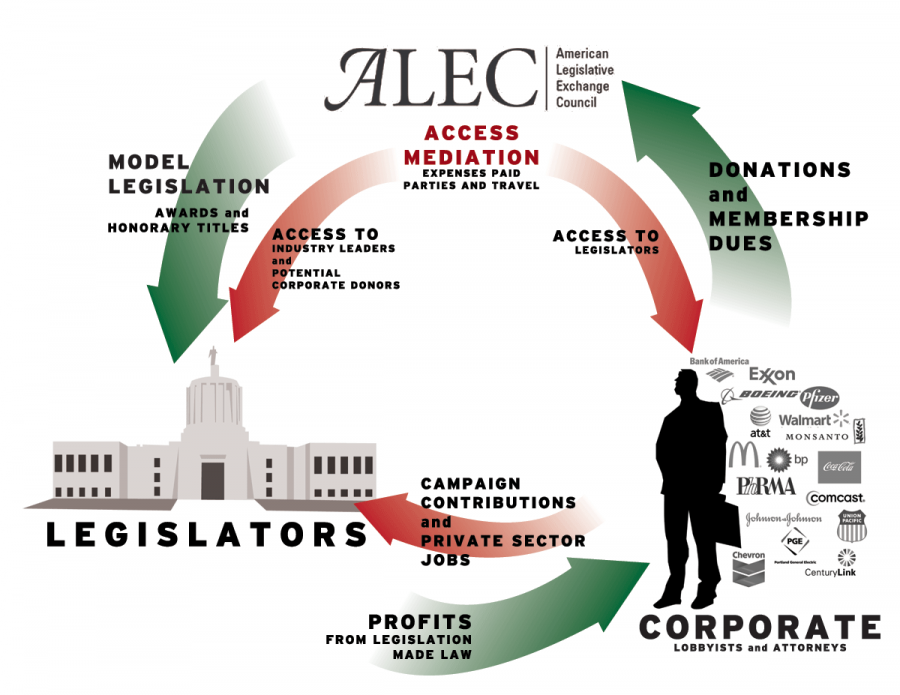
ALEC-chart-e1355768773333

ALEC (American Legislative Exchange Council) is an organization of legislators, corporations and lobbyists that seek to control the global economy. In the 1980s, ALEC was a key organization that supported the South African apartheid regime and worked against divestment and sanctions.

In 2013, ALEC engineers voter suppression laws, making sure that it’s harder for Black, Brown, Young, Old, Women and Poor people, to vote in U.S. elections. They do this in order to prevent laws like The Affordable Care Act from benefiting people with low-economic statuses. Laws like the Affordable Care Act, provide a wider opportunity for the poor to have economic upward mobility.

This is a huge issue because it prevents corporations from sustaining the creation of a permanent underclass, which would allow for companies like Walmart and McDonald’s to continue their low-wage driven pay scale, thereby increasing profits. Though Walmart and McDonald’s both ended their membership with ALEC last year, they are still implementing the same policies among their workers which prevent economic stability.

In the most simplistic terms:

The poor remain poor due to their inability to access quality education, healthcare and other life saving resources. Poor education limits the earning potential of workers and substantially increases the chances of incarceration. Due to the fact that low-income wage workers can’t afford to shop somewhere else, they end up becoming consumers among the same companies and fast-food restaurants that try to suppress their votes.

 A cycle of poverty ensues leading to stress, violence, and the constant intake of low-priced highly processed foods. Consequentially, the top four causes of death for African Americans are heart disease, cancer, stroke and diabetes. African American is not synonymous with poor, however many African Americans face historical prejudices which make it difficult for economic advancement.

Furthermore, this issue goes beyond race. Though the construction of race plays an important role in social hierarchies, people of all races and various income backgrounds are susceptible to the underclass creation cycle. ALEC and other conservative groups use race-baiting and fear mongering to prevent unsuspecting voters from recognizing this until it’s too late. By the time voters realize that they’ve been hoodwinked, their home has been foreclosed on or a family member lost their battle with cancer due to lack of proper healthcare.

Still, even these issues are first world problems. In other parts of the world, poverty can be viewed in the form of children dying from preventable illnesses like diarrhea. And though the world is often draped in luxury and decadence there are still people that die from starvation or spend their lives working 20 hr days in sweatshops and factories under the worst conditions imaginable.

Mandela teaches us that our world doesn’t have to be like this. His fight against apartheid teaches us that we must not remain silent in the face of oppression. Yes he used forgiveness and reconciliation as a tool for healing a nation. However, forgiveness does not mean forgetting. Forgiveness and its blessings cannot be fully realized if the horrors of the past are white-washed, allowing for oppression to continue thriving in various forms.

Mandela’s main leadership example was fighting against the burdens placed on the poor and marginalized people of his country by the white supremacist doctrines of the National Party of South Africa and every nation, politician or corporation that supported/looked the other way while they structurally subjugated a nation of people.  (This includes Richard Nixon, Ronald Reagan, Margaret Thatcher, Citigroup, IBM, General Motors Corp, JP Morgan Chase & Co, ALEC and many more.)

Though apartheid has ended, the battle against organizations like ALEC and corporations that economically oppress people around the world has never really ended. Mandela said forgive but he didn’t forget. And so in the tradition of freedom laid before us, let us not forget that there is still much work to be done.

JamAllen2-nb-smallJessica Ann Mitchell is the founder of OurLegaci.com & BlackBloggersConnect.com. To reach JAM, email her at OurLegaci@gmail.com.

Follow OurLegaci on Facebook at Facebook.com/OurLegaci.
Kanye’s Frantz Fanon Complex

Photo Credit: Getty Images http://www.mirror.co.uk/
Photo Credit: Getty Images http://www.mirror.co.uk/

I recently wrote an article called, “Harry Belafonte Was Right About Jay-Z.” The article went viral, generating a huge response from the Black community and beyond.  A few readers were puzzled when I stated, “Kanye West…often laments about racism but strives to uphold the same materialistic values that help drive economic disparities.” Now, I will explore this more thoroughly.

There is no denying that Kanye West has had a tremendous impact on the music industry and pop culture. From the beginning of his mainstream career, Kanye has been critical of issues dealing with racism and the structures within it. His infamous, “George Bush doesn’t care about Black people,” statement caused a media frenzy and solidified the general sentiments of the Black community during the Hurricane Katrina tragedy.

Yet it seems with more fame and popularity, Kanye’s commentary has shifted from calling out racism because it’s wrong, to calling out racism because he didn’t get a seat at the table. This is the bigger issue.

Frantz Fanon
Frantz Fanon

The distinguished psychiatrist Frantz Fanon addressed this line of thinking in his 1961 classic Wretched of the Earth. In this literary masterpiece, Fanon deconstructed the colonized mind.

“The gaze that the colonized subject casts at the colonist’s sector is a look of lust, a look of envy. Dreams of possession. Every type of possession; of sitting at the colonist’s table and sleeping in his bed, preferably with his wife. The colonized man is an envious man.”

One cannot deny the lasting effects that slavery and colonialism has had on African Americans and people of African descent around the world. In a recent interview, Kanye vehemently states, “We’re all slaves!” I understand him to a certain extent. Indeed, there is a systematic glass ceiling that prevents people of African descent and people from low economic classes from upward mobility. Even when some rise up the ranks, there are still many barriers that prevent them from attaining certain goals because they do not come from a certain class (the old money class). This is where I understand Kanye on the fashion industry. They don’t want him and they never will. He will forever be categorized as “urban,” a description he is desperately running away from because he knows that this is another way of being pigeonholed and prevented from making a significant impact (beyond blackness and urbanism) in the fashion industry.

WEB_DuBois_1918
W.E.B. Du Bois

In some ways it coincides with  W.E.B Du Bois’ description of double consciousness:

It is a peculiar sensation, this double-consciousness, this sense of always looking at one’s self through the eyes of others, of measuring one’s soul by the tape of a world that looks on in amused contempt and pity. One ever feels his two-ness,—an American, a Negro; two souls, two thoughts, two unreconciled strivings; two warring ideals in one dark body, whose dogged strength alone keeps it from being torn asunder.

However, Kanye has time and time again demonstrated that he is displeased with the system solely based on the fact that he wants a seat at the table. His anger is steeped in envy rather than reform. And this is dangerous because we get away from transforming these hierarchical structures, to unknowingly reinforcing them.

For example, this is evident in his almost complete dismissal of Black models for his runway shows in Paris. He doesn’t seem too concerned about the pains of racism unless it’s affecting his own progress. Instead, he went with the flow and continued to allow for Black models to be denied a chance at equality. He also cheers on fashion brands that are known for their lack of diversity. The fashion brand Céline, was recently boycotted by the supermodel Iman, because of their refusal to hire Black models. Meanwhile Kanye West orders full wardrobes of Céline clothing, attends their shows and sports their brand.

Furthermore, he has a lack of respect for African American history. Much like the N-Word, no matter what way you look at it, the Confederate flag represents the deep rooted oppression of African Americans. In fact, it was used as a tool to remind us of our “place.” After the Brown v. Board of Education desegregation ruling, the state of Georgia started using the Confederate flag as a sign of the good ole’ days.

kanye-west-Confederate-Flag

The painful past associated with the symbolism surrounding the flag and what it represents is no laughing or fashion forward matter. According to the Southern Poverty Law Center, about 500 extremist groups still use the cross on the Confederate Flag as a symbol of white superiority. This example is tired and old but I can’t imagine someone wearing a Swastika for fashion. I wonder if Kanye will start wearing symbols promoting the South African apartheid era next.

When Kanye speaks about racism or slavery, he’s not doing it for the ordinary people, but instead for sensationalism. He is using the Confederate flag to generate buzz, no matter how hurtful it may be.

He also has an incessant belief that Paris is the only fashion mecca and it has to let him in.  Kanye recently wanted to help the Louis Vuitton brand with his “influence.” They promptly rejected the offer.

Kanye has an obsession with getting acceptance, but not the “colored” kind. When the radio host Sway tried to encourage him to maybe create his own way, Kanye gave the now Twitter famous reply, “ You ain’t got the answers Sway.”

Indeed none of us may have the complete answers to racism and upward mobility. However, given his track record and current behavior, Kanye simply can’t be taken seriously on racism.  With every new Kanye rant we are witnessing a public display of internal conflict consisting of Fanon’s “dreams of possession” and Dubois’ double consciousness. Ultimately, he cares more about having a seat at the table with the same people he accuses of racism and classism, than bringing about change.

JamAllen2-nb-smallJessica Ann Mitchell Aiwuyor is the founder of OurLegaci.com. To reach JAM, email her at JAMAiwuyor@gmail.com.

Follow JAM on Facebook at Facebook.com/JAMAiwuyor.

Why Black Children Can’t Trust The Police

KaliefBrowder
This is Kalief Browder. Thanks to the NYPD, three years of his life are gone forever.

[Article updated on August 12, 2014]

It’s something I wish I didn’t have to say. One of the first things we teach children is to respect authority. Listen to your elders. Go ask a grown up. When there’s trouble, dial 911. But, what do you say when the people they are trained to look up to as protectors, too often end up being aggressors. I realize that millions of police officers across the country put their lives on the line every day. Their jobs are hard. It’s not easy. Yet, no one can deny the heartbreaking reoccurring reality of innocent Black youth being killed, neglected or abused by police officers and other people in positions of authority.

I often wonder how to truthfully explain police interaction to children. I image it would go like this:

1) If you’re ever in a car accident, don’t run towards the police for help. They might shoot you. RIP Jonathan Ferrell

2) If you are ever being unlawfully arrested or detained, forget your rights. Don’t speak up for yourself. Even with your hands behind your head, they might shoot you. RIP Oscar Grant

3) Try not to be at the wrong place at the wrong time, like at home when police raid it. Try to disappear into thin air. But, whatever you do, don’t be seen. By standing in the hallway, you might get shot. RIP Aiyana Jones

4) If you’re ever with an adult that is in trouble with the law, you may not be recognized as the child that you are. In fact, you may have to carry a sign with you specifically for traffic stops. They can read, “I’m a child, please don’t bash in the window next to my head,” or  “Please don’t shoot at the van that I’m in.” Ask Oriana Ferrell’s children.

5)  If you’re ever walking home and you’re stalked by a (non uniformed) neighborhood watchman, don’t try to defend yourself. Or else they’ll feel threatened and have the legally upheld right to shoot you. RIP Trayvon Martin

6) Never. Never. Never Walk home at night (or day). They will think you’re a criminal and accuse you of any crime they see fit . You might go to jail for 3 years, only to be released without any explanation. Ask Kalief Browder.

7) If you ever get lost or missing. Don’t expect them to come looking for you immediately unless you’re blonde haired and blue eyed. Just find your own way home. Ask Amir Jennings, Phylicia Barnes and countless others. RIP Latisha Frazier.

8) If you’re ever abducted and forced into sex slavery, don’t expect to be rescued. If they happen to see you, you  will not be taken to the hospital. You will be arrested for prostitution… even if you’re 13 years old (the average entry age for sex trafficking victims).

9) If you’re ever acting up at school, don’t worry about what your mother will do when you get home. You might not even go home. Jail could be your next destination, even if you’re 6 years old. – Ask Salecia Johnson.

Updates

10) If you’re ever in a car accident, don’t knock on someone’s door for help. You might get shot and labeled a criminal. RIP Renisha McBride

11) If you’re walking down the street…Nevermind. Don’t walk down the street. Don’t breathe. Don’t do anything “normal” because—> you might get shot, even with your hands raised. RIP Mike Brown

12) If you’re ever in Walmart, don’t hold a toy gun. They won’t asking any questions, even though there shouldn’t be a need to. The police will just shoot you down and come up with an excuse later. RIP John Crawford III

The list could go on and on. Though it may seem outlandish, everyone of these circumstances are a part of the everyday realities Black youth face in America. The ever present fear of Blackness robs Black children of the opportunity to have their adolescence and innocence recognized. Even as children, they’re both feared and criminalized. Though the police should be protecting them, historically racist irrational beliefs presume that Black children aren’t in fact children. This breeds serious child endangering consequences like false imprisonment, abandonment and death. Too often police officers believe their job is to protect the public from Black children and not the other way around. It’s sad to say. But right now, Black children can’t trust the police. And why should they?

The Ghost Of Nelly’s Tip Drill

nelly-1

“It mus be that a** cause it ain’t your face. I need a tip drill. I need a tip drill.”

Hip Hop artist Nelly has reignited a 10 year old firestorm about his notorious Tip Drill video. About ten years ago, Nelly was set to  launch a bone marrow drive for his sister at Spelman College. But his plans were foiled when a group of Spelman students confronted him on the issues of misogyny and the hyper-sexualization of Black women in his music videos. They invited him to speak on the issue and have an open discussion about it. Nelly wasn’t having it. He pulled his funding from the bone marrow drive and it was a huge media fiasco. However, the Spelman students did host a bone marrow drive of their own.

tip-drill111

It tarnished Nelly’s career and he hasn’t recovered since. His sister also lost her battle with Leukemia. Over the past few years, the dust has settled and Nelly has slowly reemerged in the spotlight. However, he recently appeared on the Huffpost Live show where he basically blamed the students of Spelman for the death of his sister.

He believes that they should have left the issue of his misogyny alone and just focused on bone marrow. I’m surprised ( I don’t know why) that after all this time Nelly still doesn’t get it. Those students weren’t attacking his bone marrow drive efforts, they wanted him to confront the public spectacle that he created off of Black women’s bodies. The same bodies that he was seeking bone marrow from. For some reason, he can’t see that yes this is connected. Should we only care about his sister and not the other millions of Black girls and women that are being objectified and hyper-sexualized?

Before you go there, let me say this. Yes, those are Black women in his videos that willingly consented to being objectified. They do not speak for all of us, yet unfortunately they are viewed as a representation of Black women. And the promotion of this objectification through both song and video, participates in upholding a wide spread normalization of the degradation of specifically Black women. The degradation is so normalized that more often than not, Black women and girls have a hard time getting support after being molested, raped, and forced into prostitution (sex slavery). This normalization says, “It’s okay because they’re made for this.” Consequently, Black women are often blamed for the sexual abuse that they endure.

Just take a look at this trailer for the documentary Very Young Girls.

It’s deeper than Nelly would like to think.

Nelly is refusing to acknowledge the ghost of his Tip Drill video and what it stood for because he doesn’t have to. Treating women like property and refusing to acknowledge the right of Black women to voice their concerns outside of supporting male centered thinking is the norm. More specifically, if Black women dare to speak up for the ill treatment of women and girls, we’re viewed as somehow betraying our community.

The truth is, Nelly (as he not so eloquently pointed out) is not the only one. We know through our lived experience that almost every mainstream rap song and music video is embedded with the domination of women  mentality. It was here before Nelly and it’s thriving after his short reign at the top of hip hop charts. Nelly isn’t pressed to truly think about this issue because our lived reality continuously reinforces his sentiments.

That is why what the Spelman students did is so important. They took a stand on an issue that is harming our community. And they did it despite how unpopular their stance was. We often talk about a plethora of issues in the Black community. However, things will only change for the better if we run towards our fears and truly confront the internal roles that we play. What those students did was a step in the right direction and can serve as a guide for how future generations can confront these issues head-on. One day I hope Nelly realizes this.

Harry Belafonte Was Right About Jay-Z

Harry-Belafonte

Jay-ZWith the current controversy surrounding high-end retail store Barneys and racial profiling allegations, one thing stands evident. Harry Belafonte was right about Jay-Z. In the midst of this controversy, fans have called on Jay-Z to end his partnership with Barneys, in which his new holiday fashion line is going to be sold. Jay-Z’s response has been a calculated public relations effort in which he negates any real responsibility to his default, “I’m doing it for charity” statement. Currently, Jay-Z is continuing his partnership with Barneys with his collection set to launch next week.

This “doing it for charity” response only further highlights Jay-Z’s disconnect with the masses that he often claims to represent. This notion of accepting racism in exchange for charity is downright laughable. If a charity is supposed to be helping people, why work with a store that appears to marginalize his own fan base due to class and race perceptions. Now, Jay-Z claims he’s being demonized for his partnership with Barneys. He’s not being demonized. He’s being realized.

This is where Harry Belafonte comes in. Months ago Belafonte called on Jay-Z to play a more active role in social movements and help to drive social change. Jay-Z’s response was to refer to the 86-year old civil rights icon as “boy.” Jay-Z went on to state that due to his mega star status, his very presence was “charity.”

Harry Belafonte’s critiques were not superfluous statements. They were part of an insightful analysis of how star power can be used to affect societal movements. With over 50 years of civil rights activism, Belafonte can spot both genuine and superficial involvement. The latter, is what Jay-Z is often engaged in. This superficial support of “the people” is laden with corporate driven interests.

For example, during the height of the Occupy Wall Street Movement, Jay-Z decided to make a t-shirt line based on slogans from the movement. His plans changed, once Occupy Wall Street activists asked if he would share the profits. The idea of having to share the profits (which would have helped provide much needed financial support to activists) was unthinkable to the hip-hop mogul.

Then, there’s the controversy that surrounded 2010 tax records from The Shawn Carter Scholarship Fund. During that year he reportedly earned, over $63 million but only donated roughly $6,000 to his own charity. This is not a normal practice for charity founders, who often provide a large portion of their charities’ financial costs. Out of all donors, Jay-Z reportedly gave the lowest donation to his own cause.

Finally, there is the N*ggas in Paris fiasco in which his friend Gwyneth Paltrow, decided to tweet the title of the song after attending his concert. This resulted in Twitter backlash over her usage of the term. Jay-Z, who is an enthusiastic advocate for the usage of the N-word, was silent on the controversy. Having millions among his fan base embrace the N-word is a part of his crossover hood status appeal that provides further economic security.

According to the Recording Industry Association of America, in 2012 White/Caucasian audiences represented 79% of music buys, 81% of CD buyers and 80% of digital buyers. So don’t expect Jay-Z to engage in any significant dialogue with fans about using the word. With him it’s the same old, “people give words power” and “this is the least racist generation” excuse. It’s not economically feasible for him or any other corporately invested hip-hop artist to do anymore than brush off the issue. Yet this is someone people expect to fully grasp or care about race related issues?

The African American community  has to get beyond this belief that just because someone from our community attains fame or wealth, that they’re somehow intellectually superior, a role model and someone to be admired. The same can be said for Russell Simmons with his Rush Card, Blood Diamond, and Harriet Tubman controversies. And Kanye West, who often laments about racism but strives to uphold the same materialistic values that help drive economic disparities. Do you really expect any of them to be deeply invested in activism against a classist system from which they benefit?

Harry Belafonte was right. Jay-Z isn’t genuinely standing up against racism or classism because this activism may affect profit margin (something he learned while selling crack).

JamAllen2-nb-smallJessica Ann Mitchell is the founder of OurLegaci.com & BlackBloggersConnect.com. To reach JAM, email her at OurLegaci@gmail.com.

Follow OurLegaci on Facebook at Facebook.com/OurLegaci.