The Subtleties of Mammy Honoring Ceremonies


The Subtlety Front

Kara Walker’s The Subtlety has attracted widespread acclaim but has serious conflicts that need to be discussed. 

Artist Kara Walker’s first large-scale public project is officially titled, “At the behest of Creative Time Kara E. Walker has confected: The Subtlety or the Marvelous Sugar Baby 
an Homage to the unpaid and overworked Artisans who have refined our Sweet tastes from the cane fields to the Kitchens of the New World on the Occasion of the demolition of the Domino Sugar Refining Plant.”

Having read interviews featuring Walker’s explanation of the piece, it appears to possess elements of both success and missed opportunities. The Subtlety is recognized by many as a sphinx built in the image of a “Mammy” like caricature. The sphinx is jarring. It makes people want to pay attention or at least ask questions. Her explanations are continuing a conversation about the horrors of the sugar industry’s past.

In a recent interview with The Brooklyn Rail, Walker provided further prospective about the massive “sugar baby” :

She is basically a New World sphinx. A New World thinking of the sugar plantations, the Americas, the trans-Atlantic slave trade, that sort of Rolling Stones-y brown sugar dovetailing of sex and slavery as it reaches the American imagination.

Walker was featured on NPR’s All Things Considered as well:

She’s doing what she does best: drawing you in with something sweet, something almost charming, before you realize you’ve admired something disturbing. In this case, that’s the horror-riddled Caribbean slave trade that helped fuel the industrial gains of the 18th and 19th centuries; a slave trade built to profit from an insatiable Western market for refined sugar treats and rum.

“Basically, it was blood sugar,” Walker says. “Like we talk about blood diamonds today, there were pamphlets saying this sugar has blood on its hands.”

She explains that to make the sugar, the cane had to be fed into large mills by hand. It was a dangerous process: Slaves lost hands, arms, limbs and lives.

“I’ve been kind of back and forth with my reverence for sugar,” Walker says. “Like, how we’re all kind of invested in its production without really realizing just what goes into it; how much chemistry goes into extracting whiteness from the sugar cane.”

The problem with Walker’s sphinx is that the acts of oppression during the slave trade were disturbing but the enslaved Africans were not themselves disturbing. So why continue the distortion of their image? She ends up reinforcing what she seeks to dismantle. How do we honor people who lost “hands, arms and limbs and lives” with further misrepresentations of their identities?

When critically looking at this work of art, we recognize Walker as an artistic genius. Yet even in this framework, when discussing the legacy and horrors of the sugar industry she chose to magnify the mythical overly used “Mammy” imagery. We keep coming back to something that was never truly us.

However, this issue is deeper than Kara Walker’s work. It’s been done before…this mammy honoring ceremony.  This issue speaks to the internalized limitations of imagination among artists and writers when it comes to the African descended lived experience. Lingering onto falsehoods, attempting to manipulate structures in its honor is counterproductive and often representative of an internalized glass ceiling of thought.

We can be something different because we are something different.

I’m not suggesting an attempt at ignoring the history of the “Mammy” caricature but instead I’m interested in what it would look like if Walker went beyond the restraints of this mythical being when it comes to examining the lives of enslaved African artisans.

Subtlety Back

To a certain degree, I understand the appeal of the exaggerated features of the half woman, half beast sphinx. The history of the extravagant sugar sculptures called subtleties, that were bolstered through slave labor is very important. Furthermore, featuring the genitalia of the sphinx can be viewed as taking a jab at the presumed asexuality of the “Mammy” caricature, while also perhaps conjuring images of both sexual abuse and desire. It’s crude and perhaps it’s meant to be.

Yet, the symbolism of this piece is stifled by it’s misplaced distortion and a missed opportunity to unearth what’s often hidden. In this case it would be the Black woman undistorted and unexaggerated. A jewel in her own right, without the need of leaning on identity stripping myths for significance or shock value. We can be both beautiful in our nakedness and whole in our humanity while also critiquing disturbing histories.

Showing Black women as full human beings in a holistic framework is more revolutionary than torturing old caricatures like “Mammy” ever could be…and far more valuable. When we unearth and magnify our ancestors’ true identities, outside of modes of mass societal miseducation, it will be a powerful day.


Please do not republish this article without specific, written permission from Jessica Ann Mitchell.

JamAllen2-nb-smallJessica Ann Mitchell is the founder of OurLegaci.com & BlackBloggersConnect.com. To reach JAM, email her at OurLegaci@gmail.com.

Follow OurLegaci on Facebook at Facebook.com/OurLegaci.


The Subtlety display is available for public viewing until July 6th. Full details available here

Dismantling Collective Amnesia

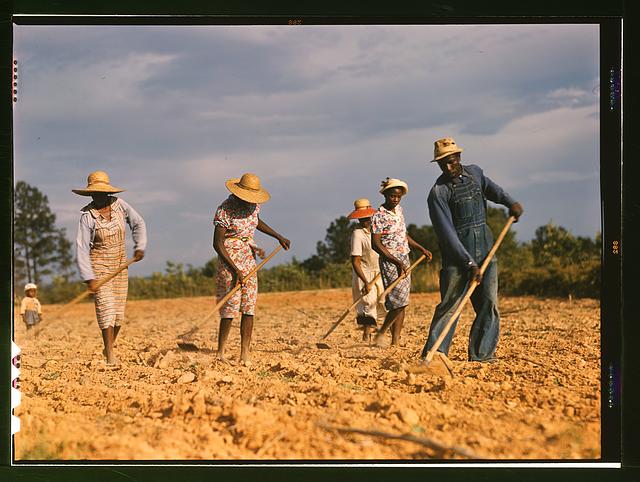
ChoppingCotton-GroupGA
Library of Congress 1941 – Chopping cotton on rented land near White Plains, Greene County, Ga.

When I was a little girl my grandmother told me about how my family came to Augusta, GA. Her parents were sharecroppers in Warrenton, GA. At the time, it was illegal to quit and you could be killed for doing so. The klan was alive and well. But my great grand parents, Flossie and George had a plan. In the middle of the night Flossie packed up the children and fled in a buggy. My grandmother was about 4 years old at the time of the escape. Afterwards, the overseer came knocking on the door asking, “Where are they?” George gave a convincing response declaring, “My wife left me and took the children.” He later quietly escaped, reuniting with his family in Augusta to build a new life for themselves.

This was my first personal Black history lesson.

They escaped a few decades before Martin Luther King Jr. discovered there were people living in Albany, GA that had never seen a dollar bill. Hangings were real, escaping was necessary, money was scarce.

Flossie and George are not people from an imaginary story.

I remember sitting on Flossie’s lap in her rocking chair. Sometimes she would chew her snuff and spit into an old can. She’d say in defiance, ” I chew my snuff and he don’t like it. But I chews it anyway.” At five years old I’d smile at her mischief…my first lesson in feminism.

Meanwhile, George would check my mouth for missing teeth. He’d then demand that my parents and the toothfairy, “Give this baby her money! Make sure they give you your money!” I’d smile at his concern…my first lesson on economics.

Anyone that reads Ta-Nehisi Coates’ masterpiece on  The Atlantic will realize that it goes beyond the traditional conversation about reparations. It’s a beautifully woven story that works towards dismantling collective amnesia.

Conversations about reparations, entitlements, and the public welfare are often scoffed over and quickly dubbed as unfounded, unrealistic and unnecessary. Then rhetoric such as Paul Ryan’s, “culture of laziness” and Rick Santorum‘s “I don’t want to make black blah people’s lives better by giving them somebody else’s money,” is quickly inserted as an effort to switch focus from the root causes of poverty in America.

Again and again we meet in battle the advocates of collective amnesia, that seek to not only ignore history but also change it.

Us descendants of the unpaid, indebted labor force are often told the past is irrelevant. Our attempts at coherent discourse are subdued as the world flashes before us and we see the hand writing on the wall. We’re told that remembering is “divisive”, this history is “non-existent”, and that most all “nobody owes us anything.”

It’s not really about owing. It’s about fixing and creating a country that is no longer mired in disparity or profitable through disenfranchisement. Recognizing that many of the current policies towards wages, education, healthcare, and housing are guided by a historically racist, classist, sexist discriminatory framework.

For me, that’s the most important aspect of Ta-Nehisi Coates’ piece…remembering and using this memory to guide us towards a more just nation.

This is why I’ll never forget the escape of Flossie and George.

– Join My Mailing List – 

Jessica Ann Mitchell Aiwuyor is publisher and multicultural communications specialist. To reach JAM, email her at JAMAiwuyor@gmail.com or visit JAMAiwuyor.com.

Follow her on Facebook at Facebook.com/JAMAiwuyor.

A Message For Writers: Push Through The Fear


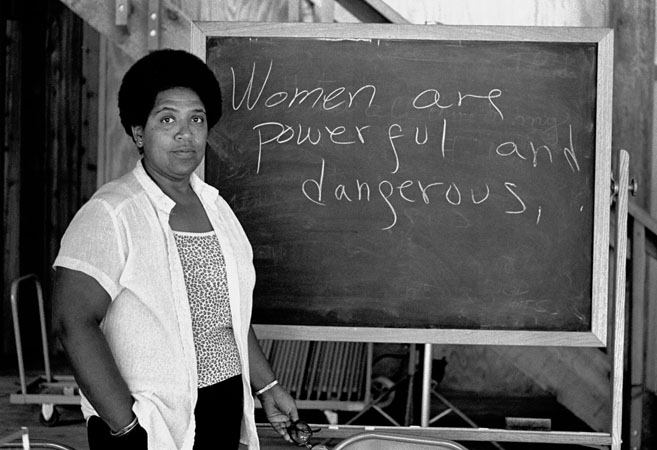
In many stages of our lives we must create spaces for ourselves and speak truths in the face of stark opposition. As a writer that touches on controversial issues concerning race, ethnicity and sexism, I often experience this. However, Audre Lorde’s A Litany Survival reminds us that fear isn’t necessarily the worst that can happen.

Chances are you’re going to face fear even when you’re silent. Chances are oppression is not going to subside because you didn’t “talk back” or because you were “well behaved.” So don’t let the popular or mainstream worldview silence you. If you have something important to say, say it. Add your thoughts to history’s pages so future generations can say that you spoke up when no one else would.


A LITANY FOR SURVIVAL

For those of us who live at the shoreline
standing upon the constant edges of decision
crucial and alone
for those of us who cannot indulge
the passing dreams of choice
who love in doorways coming and going
in the hours between dawns
looking inward and outward
at once before and after
seeking a now that can breed
futures
like bread in our children’s mouths
so their dreams will not reflect
the death of ours:

For those of us
who were imprinted with fear
like a faint line in the center of our foreheads
learning to be afraid with our mother’s milk
for by this weapon
this illusion of some safety to be found
the heavy-footed hoped to silence us
For all of us
this instant and this triumph
We were never meant to survive.

And when the sun rises we are afraid
it might not remain
when the sun sets we are afraid
it might not rise in the morning
when our stomachs are full we are afraid
of indigestion
when our stomachs are empty we are afraid
we may never eat again
when we are loved we are afraid
love will vanish
when we are alone we are afraid
love will never return
and when we speak we are afraid
our words will not be heard
nor welcomed
but when we are silent
we are still afraid

So it is better to speak
remembering
we were never meant to survive – Audre Lorde

JamAllen2-nb-smallJessica Ann Mitchell is the founder of OurLegaci.com & BlackBloggersConnect.com. To reach JAM, email her at OurLegaci@gmail.com.

Follow OurLegaci on Facebook at Facebook.com/OurLegaci.

Love Doesn’t Look Like This

Not-Love-Vintage

Over the past few days a video of a father beating his daughter has gone viral. The caption reads, “Bad parenting or is this type of discipline acceptable now a days? Father disciplines his 13-year-old daughter after missing for 3 days messing around with boys & then posts all on Facebook.”

The video shows a man beating a young woman with a belt while pulling her hair and calling her a whore and bitch. It was a horrific display of violence and brutal humiliation. A debate followed the posting about whether or not this form of punishment is appropriate. After spending way too much time debating this issue on Facebook, I felt it necessary to issue this short Public Service Announcement:

Love doesn’t look like this. 

There are many supporters of this abuse, repeating the same phrases to celebrate violence.
Here are a few examples:

1. “Spare the rod, spoil the child.” — Just as mainstream Western society is critical of Islam and the Koran about the treatment women in societies, African Americans should be just as critical of anyone that seeks to use Christianity and the Bible as an excuse for maltreatment and abuse. Self selective religious interpretation for the purposes of supporting physical violence and abuse was used during our own enslavement and colonization.

2. “If I don’t do it, the court system will do it one day.” — Black parents have been whipping their children for decades and it hasn’t stopped millions of our young Black boys and girls from going to prison. Beatings don’t solve that. Addressing overall societal issues is the leading way to prevent prison time. Beatings are not going to end the prison industrial complex because it places the complete blame on the imprisoned instead of society as a whole. It completely ignores the commercial drive of prison systems that lead to overzealous laws and filled prisons. This father’s beating is representative of a myriad of societal issues including the institutionalized usage of brute punishment over rehabilitation.

3. Some one asked me, “Have you ever had a child go missing for 3 days?” — In response I asked, “Have you ever seen child abuse?” The leading reason for runaways is physical and sexual abuse. Based on the video’s caption,  if this is what parental love looks like in her home, would you blame her for leaving or seeking love elsewhere? If this brutality was so easily displayed for public enjoyment, one can only imagine what goes on behind closed doors.

80% of runaway and homeless girls reported having ever been sexually or physically abused. 34% of runaway youth (girls and boys) reported sexual abuse before leaving home and forty-three percent of runaway youth (girls and boys) reported physical abuse before leaving home.  – National Runaway Hotline Stats 

It’s deeply disturbing that so many members of the African American community view such vicious behavior as parental guidance. Perhaps this is indicative of an overall healing that needs to take place in our community. It’s also further indicative of how we view Black girls and women. Zora Neale Hurston once stated, “Black women are the mules of the world.” Her words still ring true as to the thought process associated with the treatment of Black women. You know what you do to a mule that doesn’t obey? You beat it.

There is a pathology against Black girls and women that deems us deserving of abuse no matter how cruel or violent. This is an over present line of thinking that needs to be disbanded.

Finally, what if we are to assume for just one impossible second that this really is a father that “cares?” Is this young girl now supposed to connect physical violence and verbal abuse with love? Let’s just think about it for a second. If this is love, what is hate?

In the introduction of Gender Talk: The Struggle for Women’s Equality In African American Communities, Johnnetta B. Cole & Beverly Guy-Sheftall state:

Violence against Black people wears many faces. There’s a much needed focus on police brutality and Black male-on-male homicide, but too little attention to rape, spousal abuse, and incest. We have often been in contentious debates as well with other Black Women about the impact of gender oppression within our own communities, how we treat one another, and our hasty defense of Black men no matter how offensive their behavior. Many Black women have been convinced that there is a conspiracy by white America to destroy Black men, and as a result they remain silent about physical and emotional abuse women suffer within our communities.

This isn’t about creating divisions between Black women and men. It’s about whether we love our community enough to acknowledge gender oppression, stop silencing pertinent discussions about violence against Black women by Black men and view abuse with a critical eye. We can’t uplift, protect or love our girls and women by inflicting violence on them and calling them bitches. Supporting anyone that uses these abusive actions is not only counter-productive but in the direct opposition to the well being of our future generations. For the sake of Black girls and boys everywhere, it’s imperative that we establish early on that Love Doesn’t Look Like This.

JamAllen2-nb-smallJessica Ann Mitchell is the founder of OurLegaci.com & BlackBloggersConnect.com. To reach JAM, email her at OurLegaci@gmail.com.

Follow OurLegaci on Facebook at Facebook.com/OurLegaci.

Saving Pecola Breedlove With Lupita Nyong’o

Photo Enhanced by OurLegaci

It isn’t enough to say that “Black Girls Rock.” It isn’t enough to proclaim that “Black is beautiful.” These proclamations bear a certain level of importance but what good is it to say these things if too often our collective actions show otherwise? Show Black girls how beautiful they are, how worthy they are, how valuable they are by fighting for them.

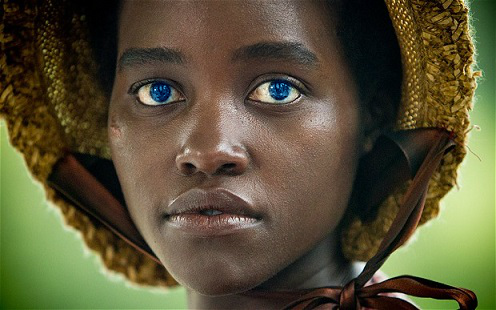
As the world becomes enthralled with the talent and beauty of Lupita Nyong’o, she continues to spread her message about the power of self love in the face of colorism. Images of her versatile beauty have taken over the internet in a display of glorious artistic prowess. Consequently, there are a myriad of discussions about the effects of Lupita’s spotlight on the millions of women and girls that look like her.

Yes, her beauty is sure to inspire, much like she was inspired by Alek Wek. But let this moment of adoration, along with Lupita’s openness to reveal her own struggles, lead to something beyond admiring beauty. If we truly want young Black girls to get the message that they are both valuable and beautiful, we have to show them by fighting for them.

lupita-fashionsizzle

Lupita Nyong’o accepted her Oscar while honoring the spirit of Patsey, the enslaved and brutally abused woman she embodied in her award winning performance. Many viewers of 12 Years of Slave wanted desperately for Patsey to be freed from her abusers. We saw the beauty in Patsey. We knew that she was worth fighting for…worth protecting. We can’t go back in time, but we can work to make sure that Patsey’s daughters don’t live a life of congratulated pain.

Abuse happens to girls of all races, ethnicities and cultural backgrounds. But when it comes to Black girls, the mechanism of race allegiance and the need to project race respectability often supersedes their need for protection. This leads to families keeping “secrets,” parents refusing to press charges, and neglect reigning supreme under the guise of keeping the peace. The ever present victim blaming then commences by calling the girl “fast” or asking, “Why was she over there if she didn’t want it?” And let us not forget the, “She knew what she was doing,” declaration. In an instant, a 14 year old girl becomes the sacrificial lamb of the Black community in addition to facing marginalization in mainstream society.

And you wonder why a girl could have color issues, wish for blue eyes or blonde hair. It’s not necessarily because she hates herself. It’s because she wants to be what she believes the world is more likely to adore and protect.

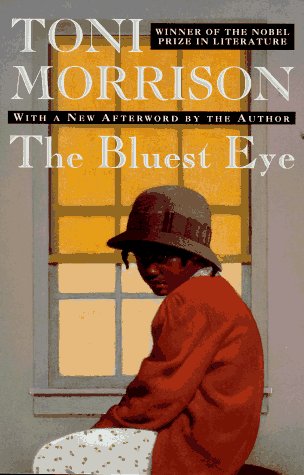
the-bluest-eyePecola Breedlove is a character in Toni Morrison’s first novel, The Bluest Eye. Pecola endured rape, neglect and various forms of abuse. She was a little Black girl, undervalued and unprotected, that wished for blue eyes.

Fighting for “her” involves building a fortress around her being. Not allowing abusers and neglecters  to have their way with “her” life. On a personal level, I know many Black woman that were sexually assaulted and abused as young girls. Their stories never made it to the news. Their abusers have gone free and the scars reflecting the pain are permanently etched in memory. They’ve all heard “Black is beautiful,” but nobody fight for them. Instead, they were blamed for their own abuse, shunned and rejected.

When you see a potential Pecola Breedlove, it’s not enough to show her pictures of Lupita to prove the existence of her beauty. We first have to protect her…show her how much she means us. We can let her know that she is not an “ugly ducking” but in fact a beautiful swan by showing her Lupita’s talent and beauty. But it is only after we protect her, that she will be able to believe and absorb this truth.

JamAllen2-nb-smallJessica Ann Mitchell is the founder of OurLegaci.com & BlackBloggersConnect.com. To reach JAM, email her at OurLegaci@gmail.com.

Follow OurLegaci on Facebook at Facebook.com/OurLegaci.

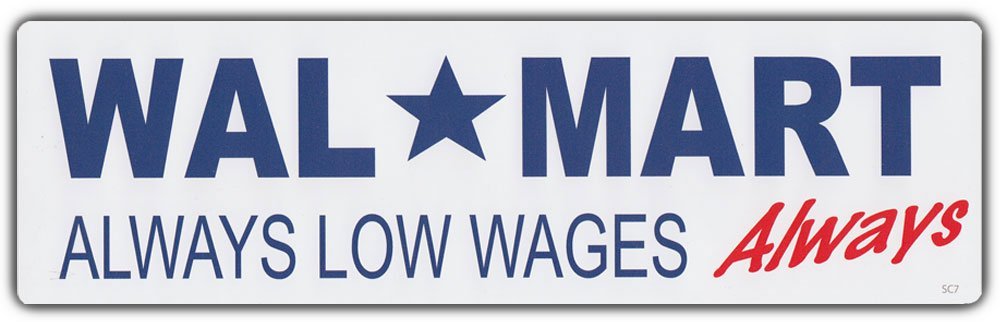
Walmart The Welfare Queen

Photo Credit: Amazon

Perhaps Walmart executives should hold a private viewing of the Lion King to learn about the Circle Of Life. After fighting tooth and nail against living wages for employees and working with ALEC, Walmart’s own selfishness is catching up with them. As one of the largest corporations on the planet, Walmart execs work tirelessly to prevent its underpaid employees from getting higher wages and health insurance benefits. Walmart now faces a 21% loss in its fourth quarter and it’s blaming the expiration of food stamp benefits.

On Thursday Wal-Mart reported a 21 percent decline in its fourth-quarter profit. The company said that the Nov. 1 expiration of a temporary boost in food stamps is hurting its shoppers’ ability to spend. It’s also caught up in the debate about minimum wages and dealing with increasing competition from dollar stores and grocers. – MSN Money

iStock_000002486895XSmall

Walmart has plans underway to open up 6 stores in Washington, DC and threatened to pull out if the DC Council approved a new living wage bill. The council approved it anyway but not surprisingly the bill was vetoed by D.C. Mayor Vincent Gray in an attempt to keep peace with Walmart.

Mike Debonis of the Washington Post states,”The city’s minimum wage is $8.25 an hour. The bill would raise the annual earnings of a full-time employee making the lowest legal wage from about $17,000 to $26,000.”  It should be noted that $26,000 is just above the Federal Poverty Line for a family of four. At a pay rate much lower than this with limited hours, it’s easy to understand why one Walmart store hosted food donation drives for it’s own employees.

Walmart’s new 21% loss means that in addition to the government subsidizing Walmart’s low wages by providing its employees with food stamps, the government is also a prime provider of funds to Walmart through its customers. Meaning that Walmart depends on food stamp recipients as a key consumer base. Now that those benefits are ending Walmart is in a crunch. Perhaps if they spent more time making sure that their employees could survive without needing food-banks, they would understand that pushing for legislation against the working class is not only unethical but harmful for business. People go to work, get paid and buy things. If they don’t have even money for basic needs like food, potential consumers are not going shopping. Walmart is a prime example of how “job creator” initiatives are hurting the economy. Suddenly Walmart is considering a new found support of Federal minimum wage increase.

Bloomberg.com reports, “David Tovar, a company spokesman, said today in a telephone interview. Increasing the minimum wage means that some of the 140 million people who shop at the chain weekly would “now have additional income.”

I guess they’re finally learning how this works.  The next time a conservative drones on about “entitlements” and poor people bashing, remind them that Walmart survives on food stamps, tax write offs and subsidies. They’re one of the biggest Welfare Queens in the land.

JamAllen2-nb-smallJessica Ann Mitchell is the founder of OurLegaci.com & BlackBloggersConnect.com. To reach JAM, email her at OurLegaci@gmail.com.

Follow OurLegaci on Facebook at Facebook.com/OurLegaci.

Fairy Tales of Reverse Racism Race Baiters

reverse-racism-450

It’s really disturbing when injustices that are linked to racism are brushed aside and we’re called race baiters for bringing it up. As if I’m imagining things. As if I created race. As if being silent is going to make everything okay. And the coup de grâce is that some unfortunate souls actually believe that by pointing out racism, that makes someone a racist. I find this to be a signifier of the failure of the education system. So many people know how to throw around the term, but so few know what it really means.

For everyone that’s confused, racism is a historically rooted systematic structure based on the creation of racial hierarchies. It’s racially based prejudices reinforced by systematic power structures that design global economic disparities, social guidelines for imprisonment, medical apartheid, and the socially determined value of life.

Just being born a Black woman in this current state of affairs, I simply do not have the structural power or capacity to be racist. And if it’s hard for you to grasp this information from me, please do Ask The White Guy and this really cool Bangladeshi Australian guy who gets it:

Still, I don’t deny that as an African American woman in the current world, I am born with a certain level of privileges that my ancestors didn’t have. For one, I wouldn’t be writing on this blog because it would have been unlawful for me to read or write. I wouldn’t have gotten two master’s degrees (that I’ve been told Affirmative Action paid for) because that too is a punishable offense. For being an uppity negro wench, I would have been hanged and buried in some unknown location and it would have been deemed justified because I didn’t know my place. That fact is the disturbing root of this discussion. These seemingly innocent demands of my silencing are born out of that same legacy. These are “be quiet or we’ll reprimand you” statements. 

Instead of trying to silence discourse, just admit that you’re a coward. Just admit that comfort and dare I say privilege is more important to you than justice. No we can’t talk about the prison system, the fall of the middle class or the military industrial complex without race. No, no, no! To exclude race from these topics is to participate in the erasure of reality and to disregard the validity of millions of lived experiences. These “reverse racism” and “race-baiter” accusations are built on nothing more than modern day fairy tales.

The racial divide is real:

Unequal prison sentencing: Check
Exclusion from the workforce: Check
Sexual abuse: Check
Segregated education: Check
Insufficient medical attention: Check

Pointing out all of these issues is not divisive, but ignoring them is.  It prevents us from fully exploring and understanding the crux of the problem. You’re not really for social justice if work ends when you feel uncomfortable. Perhaps you should ask yourself why your comfort is so dependent on avoiding the deconstruction of racism. If you’re not ready to have this discussion just admit that and move on. Remove your activist, social justice title and just “get to steppin.” But don’t try to silence people because you feel uncomfortable.  Those times are long gone. Mammy retired, leaving us very detailed instructions…being quiet is not on the list.

– Join My Mailing List –

Behold, The All American Girl

All-American-Girl

I knew it. The moment I saw Coca Cola’s Super Bowl ad, I knew there was going to be turmoil. As soon as I heard “America The Beautiful” in Spanish followed by other languages, I knew the racist, prejudiced, bigoted uproar was coming. For so long, America has lived under an unrealistic idealized expectation of “true” Americanism. It is often supported in every day speech like, “All American Girl” and “Hometown Boy.” When we hear “All American Girl,” what immediately comes to mind is a thin, blonde haired, blue-eyed woman. However, those are mainstreamed ideals of exclusion, in which people that don’t possess this look are othered and marginalized. Coca Cola as a corporation can be critiqued for many issues. However their latest commercial has added to an important discussion about who is truly American.

The truth is a girl wearing her hijab and speaking Arabic is an “All American Girl.” A young woman speaking Spanish and shopping in a bodega is an “All American Girl.” A woman speaking Igbo at church is “All American.” A “Hometown Boy” may easily speak Korean as a first language.  This is America and to think otherwise is to delude one’s self. Our identity as Americans is not preluded by a certain ethnicity, dress code or way of speaking. Additionally, critics of the commercial believe that English is the only language for America, forgetting that American English is highly influenced by a litany of cultures and languages.

Perhaps this all stems from fear. The fact it is, America is browning. According to the Census Bureau,  “50.4 percent of our nation’s population younger than age 1 were minorities as of July 1, 2011. This is up from 49.5 percent from the 2010 Census taken April 1, 2010.”

The Associated Press reported, “The government also projects that in five years, minorities will make up more than half of children under 18. Not long after, the total U.S. white population will begin an inexorable decline in absolute numbers, due to aging baby boomers.”

They go on to state:

As a whole, the nonwhite population increased by 1.9 percent to 116 million, or 37 percent of the U.S. The fastest percentage growth is among multiracial Americans, followed by Asians and Hispanics. Non-Hispanic whites make up 63 percent of the U.S.; Hispanics, 17 percent; blacks, 12.3 percent; Asians, 5 percent; and multiracial Americans, 2.4 percent.

America is getting browner everyday and this fact paralyzes some people, especially those who have become accustomed to Eurocentric ideals of Americanism. The fear of the “other” drives voter suppression laws, the prison industrial complex and racial profiling. These are enacted to prevent marginalized Americans from having full access to the benefits of citizenship.

Regardless of where the hatred stems from, “America The Beautiful” only holds true to its name if we recognize the beauty in all of America’s citizens, not just the ones that have been mainstreamed or appear to represent the dominant culture. When Langston Hughes penned those prophetic words, “I Too Am America”, he was putting America on notice. You can deal with it now or you can accept it later but I too am American. And I’m not going away.

JamAllen2-nb-smallJessica Ann Mitchell is the founder of OurLegaci.com & BlackBloggersConnect.com. To reach JAM, email her at OurLegaci@gmail.com.

Follow OurLegaci on Facebook at Facebook.com/OurLegaci.

The Unreal History Of American Horror Story

Many are calling Season 3 of the hit FX series American Horror Story the best season ever. Though I enjoyed watching this season, we need to clear some things up concerning the show’s intertwining of historical events and figures associated with Black history.

Gabourey Sidibe as Queenie. Photo Credit: Michele K. Short/FX WeLoveSoaps.net
Gabourey Sidibe as Queenie. Photo Credit: Michele K. Short/FX
WeLoveSoaps.net

Queenie’s character, played by Gabourey Sidibe, is descended from a real person named Tituba. During the Salem Witch Trials, Tituba was accused of being a witch and beaten until she confessed. However, she was never put on trial and did not face execution. There is a historical debate waging about her ethnicity. However, most historians believe she was most likely Indian or mixed-raced with African ancestry. According to historian Benjamin C. Ray, two enslaved Black women, Mary Black and Candy, were also accused of witch craft during the Salem Witch Trials. Eventually charges against Mary Black were dropped and she returned home. Candy was also found not guilty.

Photo Credit: http://tenplay.com.au/
MarieLaveau_(Frank_Schneider)
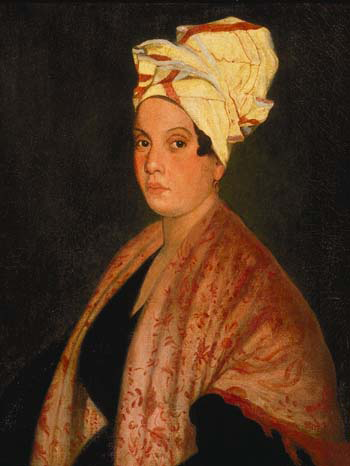
Marie Laveau

Marie Laveau, played by Angela Bassett, is a historical figure, turned into a fictional character on AHS. Marie Laveau was born in 1794 and was known for her powerful practice of Vodou . Though depicted in the show as childless (except for the one child she gave to Papa Legba), she was in fact married twice and the mother of 15 children. She even had a “junior” daughter called Marie Laveau II. According to historical accounts, Marie was loved and feared by many for her gift of foresight. She knew many secrets and was often called upon to testify in trials. She mostly kept quite, but if the defendants were mean people, she would tell all of their dirty laundry and shame their families. Though she was commonly known as the “Voudou Queen”, she was also an avid church goer who brought many people into the church fold.

The New York Times published an obituary of Marie Laveau in 1881 stating, “Marie Laveau, one of the most wonderful women who ever lived, passed peaceably away.”

It goes on to say, “Marie had a large, warm heart and tender nature, and never refused a summons from the suffering, no matter how deadly the disease. Where ever she went, she labored faithfully and earned lifelong friends. During yellow fever and cholera epidemics, she proved herself a noble, disinterested woman, going from patient to patient, administering the wants of each and saving many from death.” – NY Times  1881 Archives

Photo Credit: WeGotThisCovered.com
Photo Credit: Afrik.com
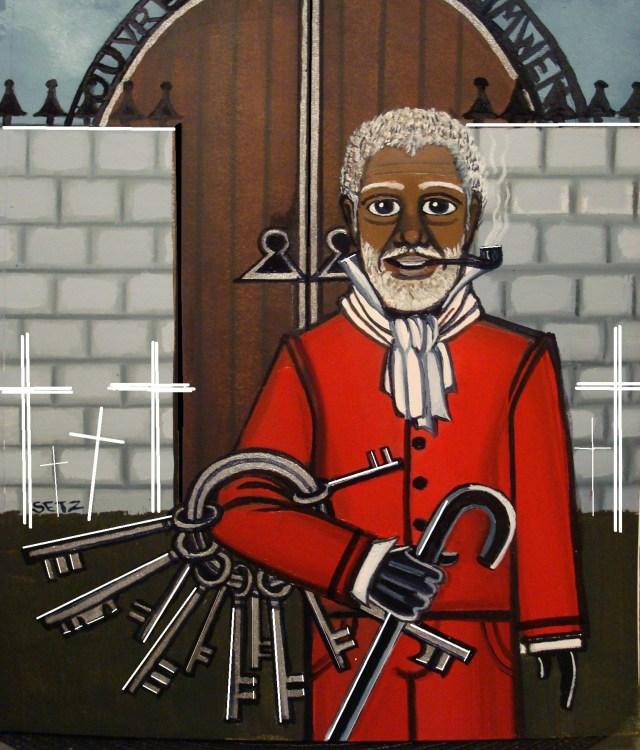
An illustration of Papa Legba. Photo Credit: Afrik.com

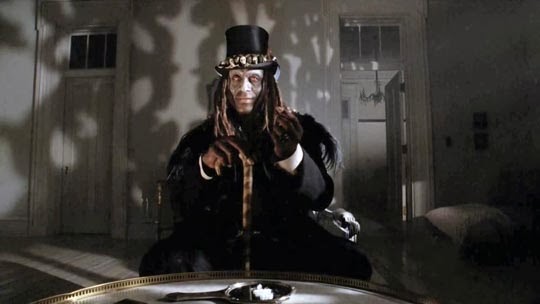
Unfortunately, for many viewers their first introduction to Papa Legba was as some sort of boogeyman figure that takes innocent babies and snorts cocaine. It has drawn much warranted criticism, because demonizing African  religions appears to be a re-occurring theme in Hollywood.

Papa Legba, played by  Lance Reddick, is an important spirit or Lwa in Vodou. According to historian Leslie G. Desmangles, “Legba is the patron of the universe, the link between the Godhead and the universe, the umbilical cord that connects the universe to its origin.” Desmangles also states,  “In his function as the guardian of universal and individual destiny, Legba is of Yoruba origin…'” Vodou spirits are derived from West Africa and are often associated with Catholic Saints. Thus to some, Papa Legba is also known as Saint Peter. However at times, Legba assumes a trickster persona called, Kafou. Still Kafou is viewed as an “inversion of Legba.” Devotees sacrifice roosters and chickens to Legba.

The word Vodou means spirit. Vodou is derived from West African Vodun practiced in Ghana, Nigeria, Benin and among various ethnic groups across the western coast of Africa. American cinema has done a wonderful job of mainstreaming the fear of Black-ness and African derived religions. Due to this fear-mongering, many people, including African descendants have become afraid of or disconnected from traditional or indigenous religions. Traditional or African derived religions have been practiced for thousands of years. During slavery and colonization, Africans and African descendants were punished for practicing their own religions, which at times led to a disconnect in understanding these religions among future generations. Vodun, like other religious practices has its benefits and disadvantages. But it is not inherently spooky or evil, these types of depictions are concoctions of the Eurocentric dehumanization of Black culture.

While many African descendants may lack historical knowledge of traditional religions, many of their religious practices in Abrahamic religions are still derived from traditional practices. This includes but is not limited to: call and response, the use of drums, repetitive lyrics, songs like “steal away” that include alternative meanings, ring shouting, and “speaking” things into existence. These are all African traditions that deserve a more nuanced understanding.

kathy-bates-american-horror-story
Photo Credit: Renegade Cinema
Delphine Lalaurie
Delphine Lalaurie

Marie Delphine LaLaurie, played by Kathy Bates was a real life serial killer in New Orleans. For years, she brutally tortured, maimed, and killed slaves. Her sick actions were discovered in 1834 during a house fire. Contrary to what AHS depicts, LaLaurie was born and raised in New Orleans and her family is of Irish descent. She was famous for hosting parties and entertaining guests. Delphine LaLaurie may have known Marie Laveau, who lived in her neighborhood. When LaLaurie’s evil acts were discovered, she and her daughters were chased out of New Orleans by an angry mob. Some believe they changed their names and fled to France.

The New Orleans Bee covered the story in 1834:

Upon entering one of the apartments, the most appalling spectacle met their eyes. Seven slaves more or less horribly mutilated were seen suspended by the neck, with their limbs apparently stretched and torn from one extremity to the other. Language is powerless and inadequate to give a proper conception of the horror which a scene like this must have inspired. We shall not attempt it, but leave it rather to the reader’s imagination to picture what it was.

These slaves were the property of the demon, in the shape of a woman whom we mentioned in the beginning of this article. They had been confined by her for several months in the situation from which they had thus providentially been rescued and had been merely kept in existence to prolong their suffering and to make them taste all that the most refined cruelty could inflict.

I’m glad that American Horror Story writers included these historical events and figures in their story line. Though their depiction is wrought with Hollywood spin and the same “old fear of Blackness” approach, more people are asking questions about these figures and opening up discussions about what is fact or fiction.

JamAllen2-nb-smallJessica Ann Mitchell is the founder of OurLegaci.com & BlackBloggersConnect.com. To reach JAM, email her at OurLegaci@gmail.com.

Follow OurLegaci on Facebook at Facebook.com/OurLegaci.

A Cure For The N-Word

At only 7 days old, a baby was called “N–ga” for the first time. I witnessed it as I visited a friend that had just given birth. The father of the new baby boy held him in his arms, smiled and said “This is my little n—a.” In my knee jerk reaction I blurted out, “He’s only been here for a week and you’re already calling him that!” The new father then corrected himself and said, “Oh, I mean he’s my little man.”

I knew what he meant. When he said that word, he was genuinely thinking loving thoughts towards his new son. Perhaps, that’s why I was so disturbed by it. His expression of love was laced with derogatory language of habit. A father has love for his first child and he articulates it by using the word N–ga.

————————————————————————————————————————————————————–

Black people saying the N-word is not the most surprising or troubling attribute of American lingo.  This is not a “Black” problem. To believe so, only further contributes to criminalizing the Black experience. The English language is ripe with coding, words and terminology that dehumanizes the “other.” Martin Luther King once stated, “Somebody told a lie one day. They couched it in language. They made everything black ugly and evil. Look in your dictionary and see the synonyms for the word black. It’s always something degrading, low, and sinister.” We are not the problem, our environment is.

Much like other modes of oppression, the N-word was used against us, to the point that some of us have become accustomed to and often perpetuate it ourselves. Almost without a choice, it becomes a stamped phrase lingering in our minds.

The phrase “My n- -ga.” is more complex than it seems. When it’s used within the African American community, it signifies a recognition of a shared experience. It’s almost like an inside joke or inner laughter is taking place towards the dehumanization. It’s like laughing to keep from crying while at the same time saying, “But I’m still here.” Within this seemingly unrecognized state of despotism, we’re surviving. Which is why for some, the song “N–gas in Paris” is triumphant. I’m not advocating for the usage of the N-word. I’m just saying, I understand. And this is what I believe many people are trying to articulate, when they say they’ve taken the word back.

This is why when perceived outsiders like Paula Deen, Madonna or John Mayer say the N-word, it’s automatically rejected. This is not done in some vacuum of hypocrisy but instead out of an often unspoken understanding that these people, do not share the lived experience of being boxed into the “n–ga” identity by main stream society. Therefore any attempts to interject within this subjugated space is viewed as appropriation or as a mechanism to further exacerbate their subjugated existence.

But how do we stop people from using it? It’s almost impossible to forcefully erase a term from common language. If people continue to identify with it, rather misguided or not, it will still be used. However, much of our concerns could be solved if we use our own legacy as a guide.” There are words much more powerful than the N-word will ever be. One of them is called Sankofa.  It’s a West African term that means “go back and fetch it.” Sankofa is often symbolized as a bird reaching back carrying an egg.The word and symbol serves as a reminder to use your historical compass to find your freedom. It’s like following the North Star.

Another word is Ubuntu. According to Archbishop Desmond Tutu, Ubuntu is  a South African term meaning, “I am because you are.” It reminds us that the humanity of one person is dependent on the humanity of others. We are all interconnected.

I’ve used these words and ideals on students before and noticed a considerable difference in attitude. My 3rd grade students, went from calling each other names to reading Langston Hughes’ “I Too Am America.” So has activist, Jarrett Mathis, who launched a full campaign on educating youth about African American history. I’ve found that once people, especially children know their history…their real history, they are less likely to think of themselves within the confines of the N-word or any other oppressive language. Their world becomes greater and expanded by the thought that finally, they can be something more than a “N–ga.”

So the next time, you hear someone call themselves by this term, try not to engage in respectability politics. Because simply being “respectable” won’t save us and never has. Instead, if the person is open to it, use it as a learning moment. Find some type of way to remind this person, who they really are. Even if they reject it initially, at least the seed will be planted.

“When n–gas become Gods, walls come tumbling.” – Erykah Badu

JamAllen2-nb-smallJessica Ann Mitchell is the founder of OurLegaci.com & BlackBloggersConnect.com. To reach JAM, email her at OurLegaci@gmail.com.

Follow OurLegaci on Facebook at Facebook.com/OurLegaci.