Black Author Spotlight: Denise Renee Ervin

About Denise Renee Ervin

Born and raised in Detroit, Michigan, Denise Renee Ervin has always dreamed of being an author. A Glimpse of My Soul, a poetry chapbook, was her first offering in 2003. In 2009, she published a novel entitled, Prelude to Praise: A Word of Testimony under her own publishing company, The Write Ingredients.

Denise was educated in the Detroit Public School system, graduating with honors from Cass Technical High School. She completed her B.A. in English at Wayne State University in and her M.B.A. in Marketing at Davenport University. While pursuing a M.Ed. degree and Secondary Teacher Certification at Marygrove College, Denise landed a position as an Adjunct Instructor at a local community college and fell in love with teaching. Denise now shares her love of the written and spoken word in the classroom as well as on the page and stage.

Denise’s calling is to revolutionize the literary marketplace and she plans to do so through The Write Ingredients. Her next project, a novel tentatively titled The Learning Curve is slated for a Fall 2012 release. More information can be obtained on this imminent literary success through her website at http://www.thewriteingredients.net or by contacting her at denise.ervin@thewriteingredients.net.

Learn about Ervin’s work:

Prelude to Praise synopsis
This tale of inspirational fiction chronicles the life of Kyla Woods through both natural and spiritual transformations, emphasizing the need to always move forward. From details about her marriage and divorce to her struggle for fulfillment and happiness as she seeks her place and purpose in the world, this story exposes the life of a Christian for what it truly is: a veritable roller coaster ride with valuable lessons embedded in every twist. Scriptural references from Genesis, Exodus, and Revelations help underscore the theme of redemption without succumbing to the triteness often present in Christian fiction. This story confirms for everyone, believer or no, that “a bend in the road is not the end of the road . . . unless you fail to make the turn.” (Anonymous)

Are you a Black author? If you would like to be featured on OurLegaci.com, email us at info@OurLegaci.com.


Being The Only Black Person At Your Job

Being the only Black person at your job can be a daunting and highly interesting experience. For those of us in the corporate world, we’ve all dealt with the awkward silences, the “hair” conversation, the name pronunciation lesson and much more. For those of us that have experienced being the only Black person at work, we often have to hide our inner feelings and thoughts in order to survive. Thankfully a web series called the Unwritten Rules, focuses on this very situation. The web series is based on a young Black woman named Racey who has just started her new job as a manager. Her first day is full of common instances that Black people deal with in the work place. After its first episode, this show quickly went viral.

Spread The Word. Share This Post!


IMG_0054-ZF-7906-35913-1-001-006Jessica Ann Mitchell is the founder of OurLegaci.com & BlackBloggersConnect.com. To reach JAM, email her at OurLegaci@gmail.com. Follow Jessica @TweetingJAM.

Follow OurLegaci at Facebook.com/OurLegaci.


The Difference Between Africans and African Americans

The difference between Africans and African Americans…

Africans and African Americans/Black Americans have deep connections. During slavery, many African cultural attributes among enslaved Africans in the Americas were retained but some were also lost (in-part) such as (language and religion). Africans, on the other had endured colonialism (slavery by another name) which presented a new dimension of issues. Due to slavery and colonialism, these connections between Africans and African American or Black Americans have been strained. Much of the tension is based on conflicting and stereotypical media portrayals that have been cross promoted among the two groups.

For the most part, many members of both groups would consider themselves Black (based on color) but at times descents of enslaved Africans in the Americas, do not view themselves as African. However, there are many African Americans that embrace their African heritage and make trips to Africa to learn more about their ancestors. There are instances when Africans do not view African Americans or Black Americans as Africans due to differences in cultural backgrounds. This is not always the case. Often times Africans bond with African Americans. In many instances both groups are essentially linked and do have cultural, economical and ethnic similarities that will forever bond them. In fact, many Africans and African Americans work together towards fighting racism and the oppression that plagues Black/ African descendants around the world.

Light Skinned Versus Dark Skinned

This issue of colorism has plagued Black communities around the world, in the Caribbean, Latin America, Africa, and North America. The debate still rages on as many believe that Black communities divide themselves based on skin tones with lighter skin tones (closer to European shades) possibly considered more beautiful. Consequently, in many circles light skinned women are often considered more beautiful. Hip hop culture specifically, is flooded with adoration of beautiful light skinned Black women. Commonly referring to them as Red Bones, Yellow Bones and etc. This has sparked controversy around the notion of self-hatred which is often linked to slavery, colonialism and the overall mis-education of the negro across the Americas.

However, there are many circles in which beautiful dark skinned women have been adored and praised as well. They are commonly referred to as Chocolate, African Queens and etc. The proverb, “the darker the berry the sweeter the juice” is often used in association with dark skinned women/people.

For Black men, darker skin tones are associated with manhood and imagery of hyper-masculinity. Such as thugs, gangsters, pimps and etc. Light skinned Black men are often associated with professionalism and at some times femininity. This is because skin tones have not only been racilized, they’ve also been gendered. Which is why darker skinned women and men face similar yet different experiences.

However, there are many members of the Black community that do not divide themselves based on skin tones. There is also an on going movement to put an end to the colorism in the Black community.


Email Newsletter icon, E-mail Newsletter icon, Email List icon, E-mail List icon
Join Our Legaci Mailing List

If You Want To Be A Writer, Write!

We all have that fear. What if we don’t succeed? What if we are just wasting our time trying to be a writer, poet, blogger, entrepreneur, etc. Its the fear of failure that drives us away from pursuing our dreams. Meanwhile, time is ticking and opportunities are passing. For those of us who are dreamers, we can’t let this happen. If we really want something, we have to go after it. If you want to be a writer, write. But write like its the only thing for you in the world.

Put your entire spirit and soul into it and never give up. We all become afraid sometimes but left fear stifle you or hold you back. So let the fear be your motivation and push through it. You never know what you might accomplish if you never really try. The last thing you want to do is waste 30 years of your life doing something that is not your passion and wondering “what if?” And if you have already spent years doing something that is not fulfilling you, know that it is not too late. As long as you are still breathing, there is an opportunity for you to follow your passion. Just do it!

Jessica Ann Mitchell has a M.S. in Public Relations and a M.A. in Pan-African Studies. Mitchell specializes in multicultural outreach and communications. She also writes on her personal blog at OurLegaci.com. To reach JAM email her at mitchelljessicaann@gmail.com.

If you believe in the power of people. Please share the link to this article on Twitter and Facebook and let us know about it. We will give you a shout-out on our next article and we’ll link to your blog or website.

The Lit Bit Celebrates Women’s History Month

Welcome to Women’s History Month!  So often we African Americans complain that the preceding month of February, Black History Month, is the shortest month of the year.  That may be, but I love this time of year since it gives me an annual excuse to celebrate Black women in history for both February and March.  Yes, I know Black History and women should be celebrated 365, but historical markers created to celebrate special people are just the American way.

The 2012 National Women’s History Month Theme is ‘Women’s Education – Women’s Empowerment.’  This year, I am lifting up the African-American women on whom I focused in my children’s book, Nappy.  Each week, I will share a list of 5 books you can read to educate your selves about these empowering women in our history.  I will also share a 1-minute video – a Nappy Narrative – with a few quick and interesting facts about my “Nappy Ladies.”

This week we kick things off with the fiery orator Sojourner Truth who fought against slavery and in favor of women’s rights.  A little known historical fact about Sojourner is that she made history by winning two court cases against prominent Whites. One of those cases ended the practice of segregated streetcars in Washington, DC almost a full century before the famous Rosa Parks bus ride!

I’ll leave you this week with five inspiring books about Sojourner Truth.

  1. Narrative of Sojourner Truth (Penguin Classics)
  2. Black Abolitionism: A Quest For Human Dignity. (Bishop Henry Mcneal Turner/Sojourner Truth Series in Black Religion) By Beverly Eileen Mitchell
  3. A Picture Book of Sojourner Truth (Picture Book Biography) by David Adler; illustrated by Gershom Griffith
  4. Sojourner Truth’s Step-Stomp Stride by Andrea Pinkney; illustrated by Brian Pinkney
  5. Great Speeches by African Americans: Frederick Douglass by James Daley (includes Ain’t I a Woman?)

Keep those pages turning,


Charisse

@CharisseCarney

Charisse Carney-Nunes is the award-winning author of several children’s books, a social entrepreneur, a literary advocate, and the Executive Producer of The Book Look a webseries airing on the African American Literary Book Club site and elsewhere.

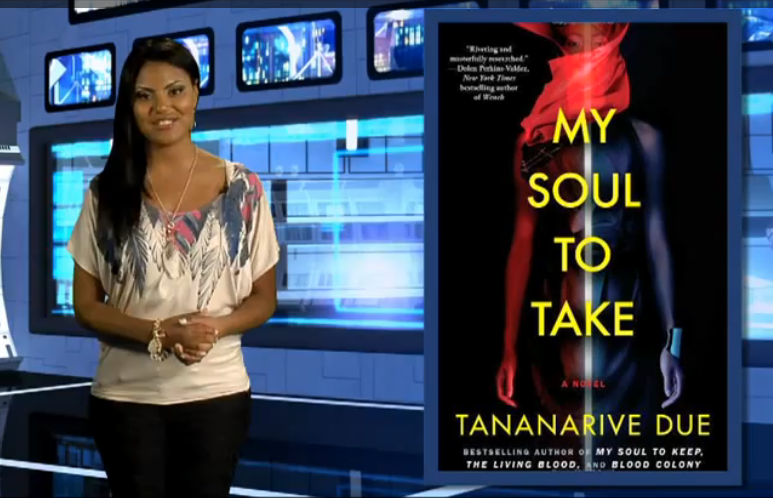
The Book Look Halloween Episode: Featuring My Soul To Take

TheBookLook.com says HAPPY HALLOWEEN! This special spooky episode features My Soul to Take, the latest in the African immortal series from black science fiction master Tananarive Due. A special appearance by Hill Harper makes this Halloween episode especially sweet.