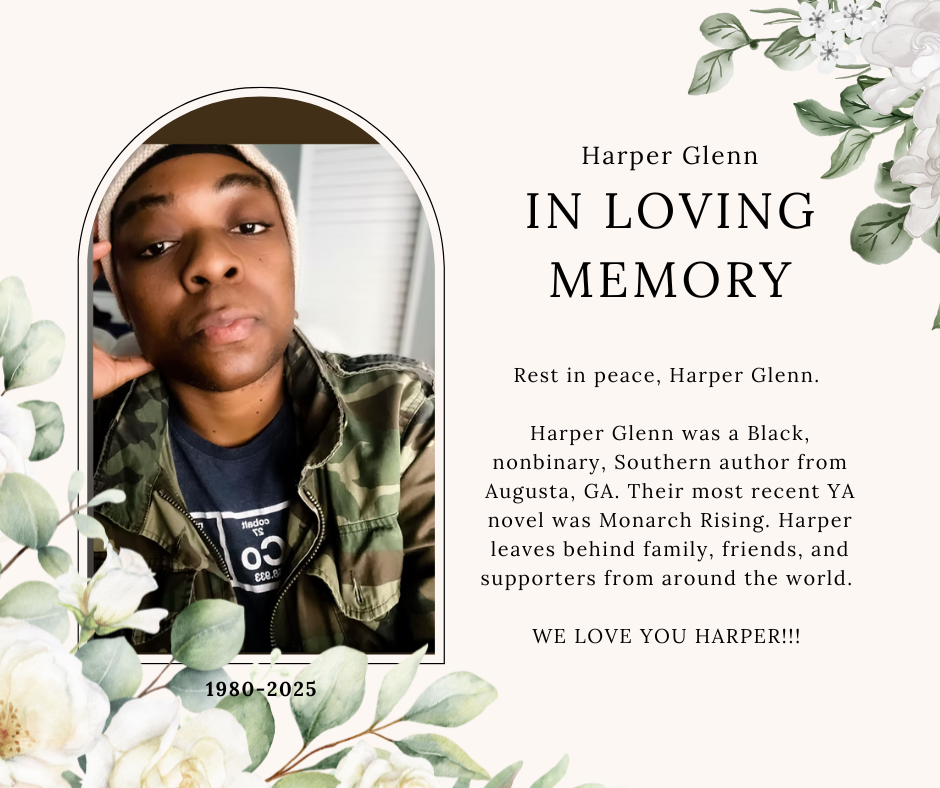
Rest in peace, Harper Glenn. Death of a brilliant writer. Words of a grieving cousin.

Harper Glenn. 

My cousin, my guide, my beloved is gone. I suppose I should do this the respectable way, so that others can understand and be informed. So here it goes. 

I regret to inform you that author Harper Glenn has passed away. Harper was a Black non-binary author from Augusta, GA. Harper’s most recent novel, Monarch Rising, is a Young Adult fiction title. Monarch Rising was a dystopian tale of a world turned upside down in a land called New Georgia, where the state of Georgia had been taken over by zealots. Not too different from what is happening now in our current political state.

My cousin, the visionary. 

Our mothers, Lisa and Penny, are sisters. Harper and I bonded over many things, as first cousins do. We debated and deconstructed religion. We loved the mystery of the spiritual world. We watched every single documentary about cults and cult followings. We both could not fathom having such unrelenting beliefs in flawed leaders and individuals. It was one of those mysteries of the human mind and condition that left us shocked. And of course, Tyler Perry fit perfectly into that because what the hell was he writing, and why can’t we stop watching?!!! 

These are the memories that bring laughter back when I think of you – Harper. My cousin, my beloved. 

Most of all, we bonded over writing. Both growing up in the deep South, our Black adolescence was shaped by our environment and the eternal questioning of it. Why were we Christian? Why did people ignore abuse and excuse abusers? Why was everyone so in unison yet an orchestrated mess all at once?

I spent many days and nights with my cousins when I was young. That’s when our childhood bond emerged. Harper was 5 years old when I was born. I don’t know a world without them and never will. We used to spend hours in our grandparents’ backyard.
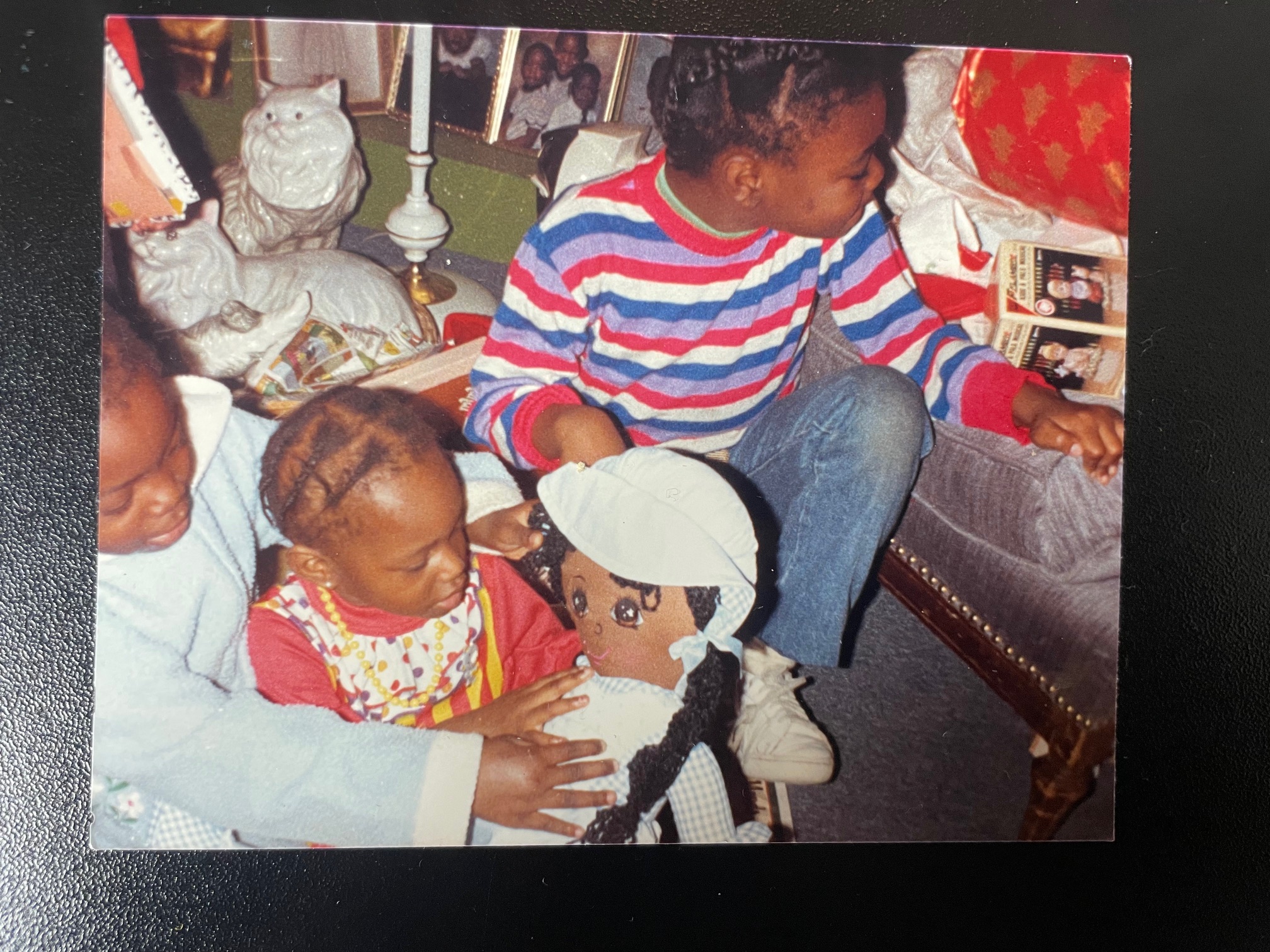
Lynette, me, and Harper at our grandparent’s home during Christmas.

We loved our grandparents dearly, and Harper dedicated Monarch Rising to our grandmother, Hattie Virginia Jones. 

Though Harper has passed, and I know Harper wasn’t religious but still had a sense of the spiritual world. And I see them. I close my eyes and I see them. I hear their voice and laughter. 
Harper always knew when something was wrong with me. I didn’t have to say anything. Harper just knew. Having both experienced some traumatic things growing up, we both turned to writing early. It wasn’t something we had planned at all. We lived about two hours apart, Harper in Augusta, GA, and I in Milledgeville, GA. Whenever I returned to Augusta, especially in high school and college, we spent days together – dreaming.

We discussed everything related to life. Our plans and, of course, writing. 

Harper was the most dedicated writer that I knew. There is a quote from Octavia Butler that states, “First forget inspiration. Habit is more dependable. Habit will sustain you whether you’re inspired or not. Habit will help you finish and polish your stories. Inspiration won’t. Habit is persistence in practice.”

This was Harper. I have always been a “write when I feel like it” type. However, Harper was in machine mode! Harper spent years perfecting their craft. Starting with a self-published book of poetry, Harper went on to write novels. Not just writing novels, Harper wrote, edited, and wrote again. Harper learned the ins and outs of the submission process. Harper connected with literary agents, joined writers’ circles, and attended writers’ chats and sessions. 

Harper was a writer indeed and a damned good one at that! 


With that type of determination, there is no option for the universe but to bend towards your will. And my cousin scored a major book deal with Scholastic! 

Harper Glenn, the published author, with an agent, with a book deal, with an audiobook, with a freaking major publisher. I’m so f*cking proud of my cousin. I am. Yes, yes, yes. 

Of course, I’m writing this with tears and snot bubbles and typing between sobs. I just need to let you know that I had an amazing, talented, caring, and wonderful big cousin who inspired me every day. Harper always knew when I was stagnant or regressing. Harper knew that a sign of my health was whether or not I was writing. And so when we would talk and Harper would be concerned about me, they would ask, “Are you writing?”

And I would say, “Weeeellll, yeah. Kind of. Well, I did draft a blog post. Or I am thinking of a book.”

Ironically, my cousin’s power of perseverance over the universe bent towards me as well. Although I had always published independently, I somehow stumbled into a traditional publishing deal for a book of quotes that documents Black history around the world. And of course, I immediately called my big cousin for advice on what to do and what to ask for. My cousin also agreed to be featured in the book. Though it was not a novel or a traditional book, Harper was proud of me and supported me nonetheless. 

Harper’s Quote in Black Voices: Inspiring and Empowering Quotes from Global Thought Leaders

Harper Glenn, the blood runs deep. 


About three weeks ago, my cousin texted me, wanting a Zoom call. Telling me, “I miss your face.” And I was like, “I miss your face too!” We missed our original Zoom time but met up on FaceTime later instead. My cousin had turned 45 years old the week or so before, and I had just turned 40. Both of our birthdays are in August. Harper is a Leo. I am a Virgo. We laughed at the fact that we were getting old. Harper said, “We are our parents’ age when we thought they were old.” I laughed and looked at their beautiful face. Harper’s skin was deep brown, smooth, and moisturized. They had also cut their hair short and dyed it blond. I thought Harper looked beautiful. 


We were both beaming and smiling, for a moment, I thought to screenshot our FaceTime, but didn’t because I didn’t want to ruin the moment or make Harper uncomfortable (sometimes they didn’t like to take pictures). 

But as we smiled like old friends telling each other an old joke, I told Harper, “Hey, we look alike.” Harper said, “Yeah, we do!” And we smiled and we laughed and we never spoke again. 

Losing Harper Glenn. 

I received the call on Monday while driving from DC back to Maryland. My mother’s voice, trembling, told me over the phone. My cousin was no more. My world is shifting; I see cars zooming past me. I can’t pull over; I’m on the interstate, and there’s nowhere to go. I fear that if I stop, I won’t get home. I need to pick up my children from school. My cousin is dead. I have to get home. My cousin is dead. I have to move this car forward. I have to get home. I’m screaming. The tears fill like a pool surrounding me.  I’m here. I’m wherever Harper is. Harper is wherever I am.

I’m here. Harper, where are you? Harper??? WTF!!!

Then I made a mistake in calling my cousin Lynette, who was having a fine day at work in Augusta. She didn’t know, and now I’ve made somebody else scream. She ended up leaving work inconsolable. Harper was our cousin, our big cousin, our love that understood us better than anybody else. 

I was talking with a close friend later that day about everything. During this time, social media was abuzz with the notion of a rapture that was supposed to happen on Tuesday. This was precisely the thing I would discuss with my cousin, and we would most definitely get a laugh out of it, while also seriously analyzing it. Thousands of people, thinking that they were going to be beamed up into the sky on Tuesday. I wanted to call them to talk about it. But here it was Monday, and my cousin was gone. 

I heard Harper, saw Harper. “Now, how you gonna leave me before the rapture?” I said.
 
They laughed, somewhere. 

Rest in peace, Harper Glenn. I’m going to be annoying now and not let anybody forget you. You always asked me, “Are you writing?” Well, I’m definitely writing now. I hope you’re satisfied. Love you, cousin.

– Jessica Ann Mitchell Aiwuyor
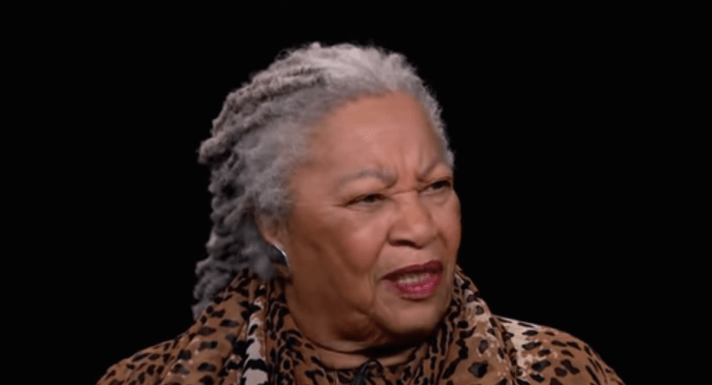
This Interview With Toni Morrison Never Gets Old

Toni Morrison Interview with Charlie Rose

In this old interview with Charlie Rose, Toni Morrison responds to a past question about if/when she will stop writing novels centered around race. She then responds with a bold answer about centering Blackness. Morrison explains that African writers, like Chinua Achebe, helped her to see the perimeters of writing without being consumed by the white gaze and how this was liberating.

The quote below hit home the most for me:

The problem with being free to write the way you wish to, with out this other racialized gaze, is a serious one for an African American writer.

Thanks to Anti-Intellect for posting this on Youtube!

Jessica Ann Mitchell Aiwuyor is the founder of Our Legaci Press. To reach Jessica, email her at OurLegaci@gmail.com. Follow her on Facebook at Facebook.com/JAMAiwuyor.

Join Mailing List

Call for Writers: STORIES OF THE BLACK MULTIPLE BIRTH EXPERIENCE

OLP Calls for Submission

Our Legaci Press is accepting queries for our upcoming anthology, Mama Twins: Stories of the Black Multiple Birth Experience.

About: We’re looking for personal essays about your experience as a Black mother of twins and larger sets of multiples.

Word length: 3000-5000 words per story.

Contributor payment: Contributors will receive a $150 payment and two author copies of the anthology upon publication.

SUBMISSION GUIDELINES

To be considered as a contributor, email a short query letter with the following information to info@OurLegaciPress.com. 

1. Send one paragraph summarizing the true story that you would like to write based on your experience as a Black mother of multiples.

2. Specify your cultural background. For example, state if you are: African American, Trinidadian, Nigerian, and etc.

3. Include a short bio of no more than 300 words.

4. If applicable, list other publications that you have been published in.

5. Deadline to submit query letter: December 15th, 2017.

View the full submission guidelines here


Learn more about Our Legaci Press at OurLegaciPress.com.

Starting a New Chapter: The Birth of Our Legaci Press

Our Legaci Press (3)

I started this blog in 2009 with one intention – write about issues pertaining to people of African descent from a place of love. It’s been a long time since my very first blog post and I’m happy to say that along this journey over 2 million people have read the articles on Our Legaci.

Though I’ve had marginal success with this blog. I’ve felt restricted in a way by the digital landscape. Though blogs are great mechanisms for sharing thoughts and ideas quickly – I feel that they are not the best mechanisms for enduring topics that require more in-depth discourse. I’ve also found that while whatever you post on the internet lasts forever – blog posts and their responses are often fleeting. Especially when discussing a hot topic or current event. The internet pretty much goes with the tide.

Additionally, I’ve found that countless Black writers are sharing amazing stories and driving intellectual thought online with little to no historical account or credit. Meanwhile, writers previously approved by gatekeepers analyze/recap these thoughts and reap the benefits of “credibility” and academic acclaim. Though much of the internet’s pool of ideas drives pertinent discussions – physical books published by reputable publishing houses ultimately hold more clout in the long run.

Due to its relatively easy accessibility, the internet has all but trampled traditional literary gatekeepers – except for with print books (though it’s trying). After much research I’ve found that Black voices are at a severe disadvantage in the publishing industry. The literary world is already tough and full of competition for authors. But for Black authors, it’s even more difficult.

Publishers often focus on stories that they believe are most likely to sell. Many people of African descent have stories that often fall outside of the perceived traditional / easy to compartmentalize/ mass appeal boxes. There are Black literary agents that help to soothe this gap by introducing publishers to promising Black writers. However, this is an extremely small pool of agents that are often overwhelmed by a flood of inquiries. Similarly, the pool of independent Black owned publishing houses is also very small and at capacity. Thus, generations upon generations of Black writers go unpublished, unheard and forgotten.

So what is a Black writer to do? Where do we go and who will publish our stories?

Well, I’m glad you asked.

It’s time to take Our Legaci to the next level. So I’m launching Our Legaci Press. The goal of Our Legaci Press is to support, publish and promote Black storytellers from around the world. We will specialize in non-fiction anthologies that showcase various aspects of the Black experience.

Stories by Black writers are essential to the development and growth of upcoming generations. Thus, we need more stories, more dialogue and definitely more books.

I will continue to use OurLegaci.com to promote the initiatives of Our Legaci Press and share information about our upcoming books and events.

I hope you join me on this new journey. I’m looking for potential editors, affiliates, outreach coordinators, partners and of course writers! We’d also love to partner with organizations and initiatives that align with our goals.

Learn more about the next chapter of Our Legaci Press at OurLegaciPress.com. If you have any questions or want to learn how you can support this initiative email info@OurLegaciPress.com.


Jessica Ann Mitchell Aiwuyor is the founder of OurLegaci.com. To reach Jessica, email her at OurLegaci@gmail.com. Follow her on Facebook at Facebook.com/JAMAiwuyor.

Join Mailing List

A Message For Writers: Stop Waiting For Permission

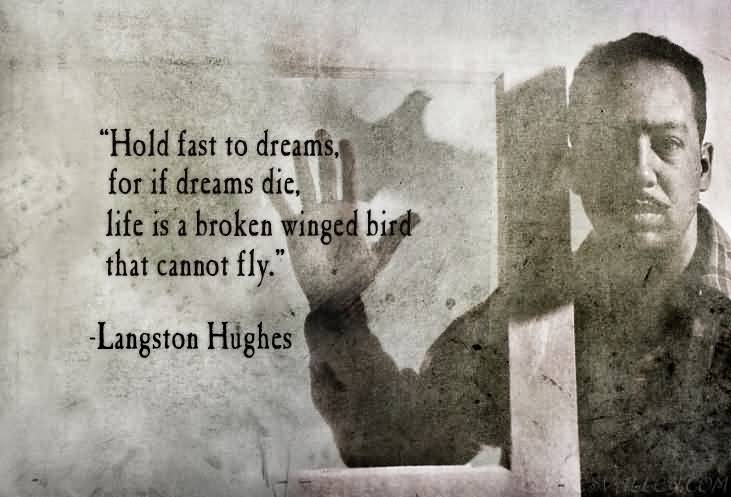
hold-fast-to-dreams-for-it-dream-die

There are so many different rivers to cross for writers. Writing is a field that presents rejection as a rite of passage. At every turn, writers are expected to present our work to gatekeepers for approval, acknowledgement, and accolades. The chase to be accepted is never ending and at times can be overwhelming. This, in turn, can halt progress. So much looming rejection, can lead us to forget why we’re writing in the first place. Truth be told, most writers didn’t first pick up a pen thinking about whether or not their structured thoughts would be accepted into a literary journal.

We started writing because we had a passion for something. We had a voice that needed to be released. We had a purpose that needed to be fulfilled. In the digital age, there is more flexibility than ever for writers to both hone their skills and move forward with their careers, without first needing the approval of gatekeepers. Some see this new found freedom negatively, desperately touting the need for restrictions. However few acknowledge that the current publishing industry is built on exclusionary, elitist practices that traditionally marginalize writers from under-privileged groups.

Are we to stop writing if our work is not welcomed with opened arms into prestigious literary circles?

If you have an idea for a book, get started. If you want to create your own syndicated column, podcast or video series there is nothing stoping you but you. Hone your craft, listen to your gut and move forward. There will always be time to submit to journals and send out proposals. Don’t let this process halt your progression.

Stop waiting for permission to be yourself and fulfill your purpose.


JAM-TwitterJessica Ann Mitchell Aiwuyor is a poet, writer and social justice advocate. She’s also the founder of Our Legaci. Rant or rave to JAMAiwuyor@gmail.com. Don’t forget to join our mailing list!

JAMAiwuyor.com
@TweetingJAM

Facebook.com/JAMAiwuyor

The Convenience of Forgetting

The-Democratic-Platform

In May of 2014, I published a piece about my family’s escape from sharecropping. I was surprised to learn that so many people didn’t know that sharecropping was slavery rebooted. The title of this article was Dismantling Collective Amnesia. It received a tremendous amount of feedback from writers and historians alike. I was applauded for both sharing and remembering the story. Still, it wasn’t as if I had a choice. Such transgenerational survival stories do not afford the convenience of forgetting.

Fast forward to April 2015. It was revealed that Ben Affleck participated in Henry Louis Gates, Jr.’s well known PBS series, “Finding Your Roots.” However, when one of his ancestors (Benjamin Cole) was discovered to be a former slave owner, he requested that Benjamin Cole be completely erased from his family history. This ancestor (that Affleck shares his first name with) would not be included in Affleck’s “Finding Your Roots” episode. This was in order to avoid being associated with his ancestor’s past. Supposedly, Gates’ team allowed this erasure to occur.

This created a firestorm, in which Gates, a renowned African American Studies historian, faced criticism. It is unknown as to how much pressure was placed on the team to exclude this pivotal component of Affleck’s family history. But one thing is certain. Affleck represents America’s denial problem. His initial refusal to include the full truth of his family’s history aligns perfectly with America’s current trajectory of denial and erasure. It’s the same premise as “all this racism with no racists.” All this oppression with no oppressors. Affleck may have been trying to deter attention from someone he was ashamed of, however he contributed to the historical denial of oppression mounted on people of African descent; as if slavery were a figment of Black imagination, and slave owners are simply fictional characters that exist only in our minds.

It’s the same travesty as schools in Texas and Massachusetts seeking to rewrite history books to make slavery appear less brutal. It’s the same as publishers seeking to detract “nigger” from Mark Twain’s books to make him appear less racist. It’s the same as the years of denial that Thomas Jefferson was a slave owning rapist.

Furthermore, Affleck’s ability to dodge this history is a brilliant display of his own racially tiered privilege. Black Americans do not have the privilege of dodging history and the pains of slavery simply because it makes us uncomfortable. Black Americans do not have the privilege of making special requests to disconnect us from being the descendant of enslaved people. So much of the U.S. Black experience is systematically connected to slavery and the imagery of servitude. There is no escaping this, no matter how factually incorrect many of these depictions may be.

The truth is many people of African descent were enslaved in the Americas. The truth is there were enslavers that made this industry possible. Affleck’s ancestor was one of them. His attempt to disconnect himself, is an attempt to erase this truth, thereby erasing the truth about how racial oppression operates and who is behind it.

Ignoring these truths is not a viable solution. Acknowledgement and discomfort is necessary in order to dismantle institutional oppression. Though Affleck is a well known liberal, his denial is representative of many white liberals and conservatives alike who seek to dodge history in order to quell discomfort and personal responsibility towards acknowledging and dismantling systematic privilege.

Current day systems of oppression thrive on the lives of marginalized groups. For example, the current struggle for living wages among America’s working class is closely linked to strategies from chattel slavery for maximizing labor and increasing profit with low wage expenses.

The plantation didn’t just produce the commodities that fueled the broader economy, it also generated innovative business practices that would come to typify modern management. As some of the most heavily capitalized enterprises in antebellum America, plantations offered early examples of time-motion studies and regimentation through clocks and bells. Seeking ever-greater efficiencies in cotton picking, slaveholders reorganized their fields, regimented the workday, and implemented a system of vertical reporting that made overseers into managers answerable to those above for the labor of those below.

The perverse reality of a capitalized labor force led to new accounting methods that incorporated (human) property depreciation in the bottom line as slaves aged, as well as new actuarial techniques to indemnify slaveholders from loss or damage to the men and women they owned. Property rights in human beings also created a lengthy set of judicial opinions that would influence the broader sanctity of private property in U.S. law. – Sven Beckert and Seth Rockman (How Slavery Led To Modern Capitalism)

In order to break these systems apart, there has to be a truthful discussion about what happened, who was responsible, and how it can be rectified. There must be a sincere attempt at truth and reconciliation.

This was Affleck’s opportunity to show his enslaving ancestor as an example of the ills of America’s past. Then show himself as a person working to rectify these ills. Instead he chose to ignore the issue altogether. For that, he reinforces a hard truth about America. Denial is chosen over healing. Erasure is chosen over accountability. Consequently, marginalized and systematically oppressed communities continue to be blamed for their own oppression, and history is laid to the wayside.

JamAllen2-nb-smallJessica Ann Mitchell is a writer, social justice advocate and the founder of Our Legaci. Learn more about her work at JessicaAnnMitchell.com.

To reach JAM, email OurLegaci@gmail.com.
Follow Jessica @TweetingJAM.
Follow OurLegaci at Facebook.com/OurLegaci.

Disappearing Words: Writing In The Digital Space


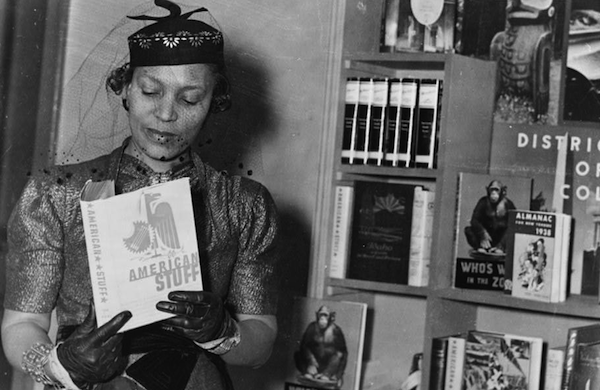
Zora Reading
Zora Neale Hurston reading

There’s something magical about writing and sharing the inner workings of your mind instantly. That’s how it works in the digital space. We’re constantly sharing, breathing new life into old words. Yet, at the same time there’s a fleeting feeling.

Another case of police brutality…write a think piece.

Another person says something racist…write a think piece.

Another person does something sexist…write a think piece.

I’ve actually come to hate think pieces. I can’t help but feel like a rat on a wheel. There’s this constant spinning motion pushing you to stay writing, stay hitting that publish button in hopes of likes or some monetary gain. I’ve heard it referred to as “feeding the beast.” The internet is never satisfied. What’s popular today is gone tomorrow, almost as if it never existed. Old suddenly takes on new meaning. Content often focuses on who can break it faster and hinders most real possibilities of in-depth analysis or nuanced discussions.

Everyone must ride the wave. Or be deemed nonexistent.

I’ve often wondered how potent their words would have been if Langston Hughes or Zora Neale Hurston spent hours on Facebook and Twitter instead of penning poems and writing books. Perhaps they would have gained a “following.”

Yet, would we value their work the same? Would their words have been added to the endless stream of brilliant yet easily discardable “latest posts?” Would we still value their time?

The problem with digital writing is there is nothing to hold on to. It’s not the same feeling as having a physical book or magazine. It’s digital, cloud based, and light like air. Thereby making digital writing feel temporary, like a fleeting gust of wind.

Though nothing ever really disappears on the internet, the quick natured environment of digital communication makes important dialogue get quickly discarded in exchange for the latest controversy.

Everyone feasts upon it, dining on every piece, tearing apart every strip. Then, on to the next one. Lack of substance becomes reality. Quick witted pseudo scholars, psychologists and self help gurus dominate droves of gullible minds simply because they’ve found the key to social media. They’ve learned to ride, even manipulate the waves.

Even with well meaning publications, writing becomes another day, another click bait. Always striving to be ahead of the page view curve makes substance secondary. Everyone is striving to be memorable without memory.

Where do we go from here?

How do we deal with the issue of disappearing words? (The fleeting times, the missed moments, the badly deconstructed ideas, and the incessant desire to be noticed.)

There are no real answers to this question. Perhaps our only choice is to be inventive: push the limits, dig, write, erase, write again, breakdown, and build up in ways that haven’t been done before. Maybe then, our words will serve more as a reference point than some random page, that once was skimmed and forgotten.

Nevertheless, we will do what writers do. We’ll keep writing, hoping the digital swindlers leave enough room for us to make an impact before our words disappear.

JamAllen2-nb-smallJessica Ann Mitchell is the founder of OurLegaci.com & BlackBloggersConnect.com.
To reach JAM, email her at OurLegaci@gmail.com.

Follow Jessica @TweetingJAM.
Follow OurLegaci at Facebook.com/OurLegaci.