"Dark Girls" Documentary Examines Colorism In Black Community

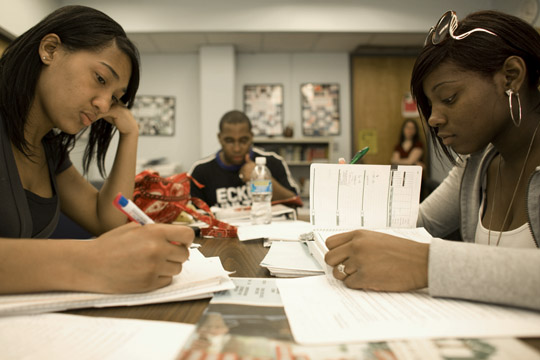
The Black community is still plagued by the belief that light skin and straight hair is more beautiful the dark skin and natural hair. Every day members of the black community divide each other based on skin tone. Even family members and friends perceive beauty based on a color scale. This is a serious problem that highlights the self hatred we face everyday.

The new documentary by Bill Duke,”Dark Girls”, examines colorism and how it affects the Black community.

Dark Girls: Preview from Bradinn French on Vimeo.

Tajudeen Abdul-Raheem and African Liberation: Don’t Agonize, Organize

Tajudeen Abdul-Raheem and African Liberation: Don’t Agonize, Organize
May 25 every year is dedicated to the commemoration of the struggle for liberation from colonial rule in Africa. Last year at the celebration of African Liberation Day in Accra, Ghana, I came face to face with some living legends of African liberation and heard their narratives of the sacrifices they had paid for Africa’s political freedom. One of these heroes, Kenneth Kaunda – the nonagenarian veteran of Zambian independence and author of the book, Zambia Shall Be Free – was very forthright in capturing the challenges and accomplishments of the decolonization movement. He also illuminated the many contemporary problems which impede the complete emancipation of the continent. The ultimate goal of the decolonization was self determination, dignity and wellbeing of Africans. But more than five decades after the end of colonial rule in most African countries, many problems still militate against these goals.

Across the continent, people are plagued by high rate of unemployment, inadequate access to quality health care and education, over-dependence on foreign aid, low life expectancy rate, brutal dictatorship and pseudo-democratic leaders, gender inequality, and all sorts of threat to the future of the African child. One may even want to question the meaning of African liberation as the continent still does not have enough bargaining power to negotiate a global agreement against the disproportionate threat of global warming to the survival of the continent – a threat so grave that there are concerns that the emission level agreed upon by the powerful states would, as noted by Archbishop Desmond Tutu, “condemn Africa to incineration.” Against this backdrop, some people ask whether African Liberation Day is worth celebrating.

However, after my experience at the African Liberation Day in Ghana, I gained some clarity that informed my opinion: we must not trivialize the labor of the past heroes of Africa’s liberation struggle; we must celebrate the gains that have been made, while taking inspiration from the old struggles to confront contemporary challenges. This clarity was taken to a higher level after my familiarity with the writings of Dr. Tajudeen Abdul-Raheem.

In our quest for inspiration, we should not only focus on the achievements of the African liberation heroes of the 20th century. We need to draw on the life and deeds of 21st century Pan Africanists. A symbol of this new brand of Pan Africanists was Dr. Tajudeen Abdul-Raheem, who demonstrated that the younger generation should not agonize about the current state of the continent but stand for what is right and organize to complete the African liberation process.

Dr. Tanjudeen Abdul-Raheem (1961- May 25, 2009)

Dr. Tajudeen was born in Nigeria on January 6, 1961. He was steadfast in his commitment to speaking truth to power and standing for the ordinary people. After obtaining his bachelor’s degree in Nigeria with first class honors, he studied politics at Oxford University in the UK as a Rhodes Scholar. When he was interviewing for the Rhodes Scholarship, Tajudeen asked the interview committee to explain to him why they thought someone like him would want to be associated with an imperialist such as Cecil Rhodes who committed racist crimes against Africans. This question, however, did not get in his way to becoming a Rhodes Scholar.

He dedicated his life to organizing for Africa’s transformation. He was secretary general of the 7th Pan African Congress held in Kampala, Uganda in 1994. He led the organization Justice Africa (which he helped found in 1999) to engage the African Union on issues that concern the wellbeing of the ordinary African. He was one of those at the forefront of pro-democracy struggle that delegitimized military rule and enthroned democracy in Nigeria. A co-founder of the reputable Center for Democracy and Development in Nigeria, Tajudeen was also the general secretary of the Global Pan-African Movement. He was Deputy Director of UN Millennium Campaign for Africa, and also gained a reputation as was a critical commentator and writer who drew attention to what should be the core of African liberation in the 21st century.

Dr. Tajudeen was blunt but nuanced in his critique of African leaders who were once part of the liberation movement but derailed from the goal of emancipation in the course of perpetuating themselves in power. While space will not allow me to analyze all his writings, the titles of many of them were reflective of their theses, and they include: “Corrupt Leaders are Mass Murderers;” “Respect Term Limits for Democratic Change;” “Rule of Law or Law of the Rulers?”; and “Mu’ammer Gaddafi: The Brother Leader is Wrong on Revolutionaries in Power Not Retiring.” The others include: “Zimbabwe: As Good a Place as Any to Draw the Line;” “Justice for Zimbabwe Regardless of the West;” “Does Meles (Zenawi) Think He’s Africa’s George Bush?”; “Africa: The Many Challenges to Human Rights in Africa;” and “Presidency in Perpetuity.”

Tajudeen’s commitment to the emancipation and wellbeing of ordinary people in Africa was nonnegotiable. He displayed this in his encounter President Yoweri Museveni of Uganda. Museveni once sent Ugandan intelligence operatives to Nigeria to help Tajudeen escape from jail, where he was detained by then Nigeria’s brutal military ruler Gen. Sani Abacha for opposing his military dictatorship. Despite this help, when Museveni manipulated Ugandan laws to perpetuate himself in office, Dr. Tajudeen was the first to lash out against him. The issue of responsible leadership raised by Dr. Tajudeen some years ago has resurfaced today in the midst of growing discontent towards African leaders by their people.

Dr. Tajudeen was also preoccupied with issues affecting women. He wrote about “Ending Violence Against Women;” and affirmed that “Mothers Should Not Die Giving Life.” Recognizing the burden of liberation and transformation borne by women, Dr. Tajudeen wrote that “Everyday Should be a Woman’s Day.” He worked for African Unity and wrote: “Why We Must Struggle Against Xenophobia!” He also wrote about “The Demand for Common Citizenship;” and about “Taking Pan-Africanism to the People.” Dr. Tajudeen mobilized people to “Stand Up Against Poverty,” and cautioned against aid dependency, noting: “Live Aid 2: ‘It’s Like Trying to Shave Someone’s Head in Their Absence.’” He backed up his activism with fervent grassroots mobilization and asked others to do same.

Don’t Agonize, Organize

We lost Dr. Tajudeen Abdul-Raheem, though not his ideas. In 2009 on Africa Liberation Day, Dr. Tajudeen died in a car accident in Kenya on his way to launch a maternal health campaign in Rwanda. While he was alive, Dr. Tajudeen made us to understand that the struggle for Africa’s liberation continues. He clarified that we must appreciate the sacrifices and achievements of the past and that we must be conscious of the challenges of today. We must never agonize about the problems. We must speak truth to power and organize to confront the challenges. The inherent power of his dictum, “don’t agonize, organize,” is being displayed in Egypt, where people have mobilized to put the society on a new path.

I would recommend that young Africans and aspiring leaders, who seek to put their passion for better society and human dignity above everything else in Africa, read Dr. Tajudeen’s work and seek inspiration from his thoughts on African liberation. His writings have been compiled in a compendium, titled Speaking Truth to Power: Selected Pan-African Postcards.

On this 2011 African Liberation Day, we remember Dr. Tajudeen Abdul-Raheem as one Pan Africanist and humanist who made a mark by helping us with ideas about the central focus of African liberation and Pan Africanism in the 21st century: the restoration of the human dignity and wellbeing of all Africans from the stranglehold of corrupt and despotic leaders and their foreign accomplices. Yes the celebration of African Liberation Day is still very relevant. Don’t agonize, Organize!
……………………………………………………..
Wilson Idahosa Aiwuyor is a researcher. A graduate of International Relations from the Maxwell School of Syracuse University, he is also a Public Policy and International Affairs (PPIA) Fellow at the Woodrow Wilson School of Princeton University. He could be reached at aiwudaho@gmail.com.

In The Company of Smartness: Black vs. White Intelligence

In The Company of Smartness: Black vs. White

Brain Power Funkdafied. Who has the monopoly on intelligence? The answer will shock you.

by Peggy Butler

Americans enjoy having a wealth of information at their fingertips. Interested in knowing who was the first African-American granted a patent? The answer can be found via books, magazines and the Internet. Based on our massive databases, one would be hard pressed to find anyone who still clings to the theory that Blacks are intellectually inferior, right? Wrong. Welcome to Reality Complex 101. This organization is comprised of millions of Europeans who are convinced, that when it comes to academic prowess, White reigns supreme.

This asinine theory was depicted in the 1994 best seller “The Bell Curve.” The book’s authors Charles Murray and Richard Hernstien concluded, there is evidence suggesting “Blacks are genetically less intelligent than Whites.” This long held belief, remains one of America’s most disturbing myths. The Bell Curve created an uproar among African-Americans who characterized the book as literary garbage, cleverly concocted by two White males, as a gesture of racial superiority.

The Age of Pre-Civilization

Prior to the 20th century, this erroneous perception may have appeared true, based on the fact; Blacks were denied an education. During slavery, Whites felt that slaves were less likely to create problems if they remained illiterate. Sound familiar? Plantation owners were fond of saying, “The best slave is a dumb slave.” So determined were Whites to keep slaves from learning, schools were burned down, and teachers were sent packing. In putting education in its proper perspective, a few owners taught their slaves to read the Bible, but any education beyond that was forbidden.

Throughout the ages, questions regarding Black versus White intelligence continue to surface. If you ask the average Caucasian who’s smarter Blacks or Whites, you will in all likelihood hear a myriad of answers. However, An emphatic NO, would be the logical response, if the person asking the question was of European origin and the person responding was African-American.

Nonetheless, among each other, experts contend Whites are wholly convinced, they are smarter than the average African-American. “ Historically, this is a stereotype that is fervidly entrenched in the Caucasian race,” says Laura Morton, a retired English teacher whose roots are tinged with Irish and German genetics. “There are two things that Whites are absolutely certain of,” she stressed emphatically. “The first is that blond haired, blue-eyed women, are the most beautiful creatures in the universe. And the second fallacy, is, Whites are smarter than Blacks.” She further noted, “Although studies have proven that the latter is false and without merit, secretly, Whites still cling to this myth.”
For those who cling to the notion that intelligence is the result of genetic factors, this is nothing new. Traditionally, some groups are perceived as being smarter than others. In The Bell Curve, Murray and Hernstien ranked Asians as being the most intelligent race.
In accordance with their logistics, they assessed Asia and China as having the smartest inhabitants. And why shouldn’t they be smarter? Kids in Asian countries generally spend longer hours in school than Americans. But what about Blacks and Whites? Is there really an intellectual imbalance between the two races?

Coping with Racial Differences

In my travels down America’s Mean Streets, I am convinced that intelligence is simply a state of mind. Nonetheless, there are things about the intellectual skills of Blacks that disturbs me in comparison to other races. For example, I get discouraged when year after year I notice that few of the national spelling bee champions are Black. I also find myself getting upset, when I ask a 16-year-old to name the seven continents, only to have him respond sarcastically, “I don’t know.” Only to have a 12-year-old White youth recite them alphabetically, and in 15 seconds no less. Does that mean the 16-year-old has a lower IQ than the 12-year-old? Not necessarily. What it does mean, is that parents must embark on the awesome task of placing more emphasis on academics. Is that a thud I hear? Or the sound of brains evaporating from their idle cells?

I am also puzzled as to why African-Americans spend more time watching TV than reading. This is true of both children and adults. Such arrogant disregard for knowledge reminds me of a quote I once read: “If you control a man’s thinking, you control every fiber of his overall being.” Hello! Are you feeling me now?

Another theory involves environment. In homes where there’s an abundance of books, and everyone in the family is an avid reader, there is a strong possibility the child may develop a potent interest in learning. At the other end of the spectrum, if a child lives in a household where books are inaccessible, and reading is considered a chore rather than a pleasure, the child may show little interest in receiving a quality education.

But can intelligence be measured? Some people think so, while others argue it’s highly improbable. As for me, I say it’s all in the brain stem. There are smart Black folks and smart White folks. Feeble-witted Black folks and Feeble-witted White Folks. The only difference between them and us experts contend, is that when they pick up a book they read it from cover to cover, beginning with the Table of Contents and culminating with the Appendix. Whereas, Blacks maintain we pick up a book, simply to see if it’s worth browsing. Yes, I enjoy being in the company of smartness. Too bad the line is so short, and the good intentions a tad too long.

Peggy Butler is a freelance writer that specializes in topics that affect African-Americans.
http://www.peggysbutler.com
twitter.com/peggybutler647

All Of Us: Documentary Examines Power & HIV in Relationships

Our Legaci Response:

This documentary highlights vital information for understanding the HIV/AIDS epidemic among Black and African Women. Sometimes, power roles in relationships, vulnerability and past experiences of abuse can make women predisposed to catching HIV/AIDS. “All Of Us” shows the lives of young women fighting HIV and telling their stories. It is an absolute must see documentary for all people of African descent that are concerned about how the HIV/AIDS epidemic is affecting our communities.

Sister Love/Sister Pain

Sister Love/Sister Pain

By: The Poetess–Vivian Dixon Sober aka The Ms. V

Love is not red—deceiving indeed, circumstances in place—solid as a rock—love can slip in and dismantle a complete heart
When love happens unpredictably, it throws mind control off
Can’t do nothing but flip your mind a thousand times trying to re-invent the fairy tale scene that seemed like a dream
He entered my heart when it was in lockdown and I didn’t even know
I have no mind control—emotionally—I’m a wreck
I can’t catch a thought
Heart, dear heart, please release me
How did I fall in love
I thought I was in love with my husband—I knowI know
I’m married and lonely and that’s a hard thing to be
Instead of looking at me he’s looking at pornography
I can’t compete
That is out of my league
I’m a woman—and I’m going to continue to be
I got involved with another man—a friend who listens to me—he is deep—concerned
I’m in a war—an emotional war—I didn’t realize the need he filled—I’m in love with another’s man
Now I can understand what I never could before those songs about married people creeping
struggling with love: Me and Mrs. Jones, Secret Lovers, If Only For One Night
songs such as those
doesn’t make it right
“If you can’t keep your man, I can,”the new love says on demand
I can’t say that; it just happened; I can’t explain it
I wasn’t looking for love especially forbidden love

I have morals—what’s up with me—I’m recognizing other parts of me that aren’t very sweet and the problem is: Do I care?
Thoughts streaming through my mind
Is the issue really about a Queen who can’t keep her husband or her man or is it about a sister who just thinks she can’t
I’m a thinker—a contemplator
I can’t elevate myself above his wife as being better than she, his Queen
Sister Love/Sister Pain is killing me
I wish love were red then I could change the color and feel no pain
a heart full of love overflows with emotions—stomach hurts—can’t eat
can’t sleep—weight falling off because I want to be with him
Love is not red mind inundated with him if I see him I will get well
I saw his feelings for me in his eyes; he stared at me too long if I were a magnet and he a
piece of steel l’d be in his bed disrespecting myself and his wife that’s not what I want in my life—I love him—I truly do
This is not cool; I’m not a fool
I have examined the stained picture I see people acting emotionally violating vows made
before God: “If she can’t keep her man, I can”
Everything done in the dark will be revealed and how will the Sister he belongs to feel
I have a man and a license to make love to him, but when love crept in my heart my battle was to stay sane not have sex with no feelings there was nothing for me to gain
Along the road of life I fell in love twice
I love my Sister’s man
My heart aches—anguish—pure blue
Can’t obey and cause her pain
He belongs to another; She will not pain because of foolishness
I know the pain of women who do not think
Sister he is yours I will move on
I will not be intimate with him as that will cause pain
Love is not red: it is blue and rides a roller coaster of emotions
I am no better than you, Sister, as you are his Queen
and much more important than me
I can see
It’s not about a color scheme or age difference
A woman is a woman with a heart that can bleed
I just want something exciting and new and that will end if I hurt you
Life happens; the love is stained with too many faces this is no game
I can’t play—I love a man—he loves me too but sister love stands above
My sister will not shed one tear or lose weight or sleep because I’m in love with her man and can’t control myself
He will be with me today—if I want it that way—love has nothing to do with hurting you
The pain will be all mine I will be used and your husband, your man will return to you and despise me
Now I know the makings of affairs; things ain’t right at home husbands and wives lose sight mundane love lives nothing exotic anymore so they find what they need it doesn’t make it right but, hey, stop telling your wife to go fly a kite
Women boast about sleeping with another’s husband–if he were your husband would
you boast or cry and lose weight in time:
I saw his feelings for me in his eyes: he stared at me too long
If I were a magnet and he a piece of steel l’d be in his bed disrespecting myself and his wife that’s not what I want in my life—I love him—I truly do
This is not cool—I’m not a fool
This is a fight I don’t want to win: I just can’t do it though I want to
I feel like I’m being driven; I’ve been on the other side—I cried and I cried
Sister love conquers devastating affairs: I’m not his wife my love must die
Although I am suffering my Sister is living how am I going to build happiness on some one else’s pain: “if she can’t keep her man, I can.” evaluating myself over his queen
What makes me think I am better than she?
Real love is not about taking
a Sister’s man—even if I can what can he do without me I have nothing his wife doesn’t have. I’ll live in her shoes tomorrow “if she can’t keep her man I can.”
My home girl called me a fool—really—and she’s cool
Well let’s take a look at her; she and Mr. Jones
Bi-polar you riding too high living a life based on lies “if she can’t keep her man, you can.” ‘til you see the light you fell from your pony when he left you for his wife
your mind—psychotic—your stomach in knots—can’t sleep—eat
Your weights falling off can’t accept the fact that you were used and thoroughly confused
Bi-polar you thought you could build happiness on someone else’s heartache
Where are your friends? You are caught in your own web so sleep in your bed
You didn’t think about your Sister: you thought about you—the pain is great—overwhelming—too deep—steep
He crept and you wept, “if she can’t keep her man, you can.”
Your tormented mind told you lies; I just can’t
The next time tainted love knocks on your heart’s door
stop, drop, and roll smother the fire before it consumes you
Tainted love is nothing sweet; it’s not a treat send that man home
where he belongs before you are used like a junk-yard dog
the choice is yours: but I’m stupid
Cupid’s so-called arrows often strike the living dead: I am thrilled just to know
that I can love and love deeply: being married and lonely is dangerous
Husbands wake up; Wives, wake up
Sister Love/Sister Pain is killing Me
No affairs
Husbands who ignore
Curb gear for the garbage man


Vivian Dixon Sober©2003
All Rights Reserved

My duty is to stand up and speak about the injustice and lies and fight them back with love, unity and action

My duty is to stand up and speak about the injustice and lies and fight them back with love, unity and action.

Written by: Christina A. Jeter

http://www.linkedin.com/in/christinajeter

http://www.cjeter.com

Now that I have educated myself on life, I choose to help others with their transitions without having them go through the same mishaps I entailed to have a peace of mind. The beauty of the world is more than what is being glamorized on television aka the media. Born into a world I seem to know little about, I try to educate myself on its history, while the more I find out daily, the more I become disgusted in humanities ways. I pray that those who are quick to be cruel to those that are different will open their eyes before Judgment Day as they are to me truly being tested.

Life is like a new business venture and this to me is a strategy of making yourself successful and how do you do that, first you create a plan and implement steps to achieve those goals of success.  Now as you put those steps into action you will see that in some areas you succeed and some you fail, instead of tossing your hands in the air and giving up, you apply the actions of success to the areas of failure to make a turnaround in your progression of life.

My Grandfather was born in an era where he had to witness and took the action of society mistreating him, he could have fail victim to the hatred being giving to him and let that stop him from becoming a success, but he didn’t! He traveled; he educated himself, created a profitable business to provide for his family.  I celebrate being black year round because my grandfather has passed down genetics that entails I WILL NEVER FAIL, I ONLY ACHIEVE SUCCESS DIFFERENTLY FROM OTHERS!

GOD had blessed me with many things and one is my education, now knowing that there are many African Americans that should be taught in school and celebrated during black history month besides Rosa Parks, Martin Luther King, and Fredrick Douglas. I encourage everyone to read up about Andre Cailloux (Stephen J. Ochs- A black patriot and a white priest), Felicie Coulon, Gabriel Prosser, Marie Laveau, Rose Nicaud, Francis E. Dumas and Jules Lions.

People of my past and present inspire me to make a change every day and that is what I try to do with my writing. Many things plague the world today and the majority of it is labeling, now while we all have the right to freedom of speech and our opinions, I still should know the connotation of the words I direct to an individual. I educate myself on the different lifestyles of the world and with that I may not agree with it but I respect it. My sensitivity comes from the fact that I have faced bullying and realize, “Rejection is GOD protection.”

We all want power; just watch how you achieve it and what you do with it!

They Say Hispanic…I see Black: The 21st Century and the DuBoisian Color Line is Still An Issue

They Say “Hispanic”…I see “Black” :The 21st Century and the DuBoisian Color Line is Still An Issue
By Timothy Aaron – Styles c2011

According to all indicators, the “Hispanic” population grew by 43% over the last 10 years pushing the actual numbers to over 50 million. Now, according to sources such as The Census Bureau, one out of every six North American (United States citizen) is “Hispanic.

I keep hearing this statistical, numerical and quantitative fact reported however there is one historical and cultural truth that I am not hearing, except in my own head and out my own mouth: many, if not most, of the people classified as “Hispanic” are actually of African descent and “Black.” With this in mind, my logic says if the Afro-Hispanic population is increasing in numbers, so are the number of regular ole “Black” folks which means – Black folks, overall, are becoming the “new” majority. Then why don’t they just say that?

For the record, there is really no such thing as a Hispanic “race.” As an aside, I must say that I am one of those reluctant to use the term “race” to distinguish (between) various peoples. If one believes that there is only One Human Race, then how could there be other races? How could you have sub – races? Wouldn’t a “sub – race” mean that there are “sub – humans”? Personally, I prefer using either of the following terms to classify and differentiate human beings: ethnicity, culture or nationality. But, that’s another narrative deserving more exploration and discussion at a later date.

Hispanic (or Latino) peoples are people comprised of indigenous Native North, Central and South American nations including the Caribbean (e.g. Taino, Arawak, Carib, Aztec, Mayan, Calusa, etc.); Africans; and Europeans (Spaniards and Portuguese). Their ethnic and cultural origins are traceable to either or all of these groups.

As it is well documented, the Spanish and Portuguese presence in the Americas is primarily due to colonialism – what some euphemistically refer to as, “exploration” and “discovery.” Later.

It is the Spanish and Portuguese presence that put the “Latin” in Latin America. While there are remnants of indigenous/Native and African culture throughout the “Hispanic Diaspora,” primarily, it is the Spanish language that defines, connects and “unites” Hispanic people. Put another way, the major commonality and criterion used to classify “Hispanic” peoples is the Spanish language. The term “Hispanic,” then, is primarily based on linguistics and secondarily on culture. Again – ethnically, there is no such thing as “Hispanic.”

Interestingly enough, Spain owes so much to Hannibal the African for the development of its civilization and culture. Oh, the complexities of history, culture and identity. Another topic for another time.

In nations like Panama, the Dominican Republic, Puerto Rico, Argentina, Brazil, Ecuador, Cuba, Peru, Mexico and Columbia – you will find many Black people, as well as clear African cultural influence in and through food, music, religion/spirituality, architecture, art and language. In some cases, probably rare, I will admit, you will find that the African culture is the dominant culture such as in Brazil, Cuba, Panama, Puerto Rico and The Dominican Republic.

So I find it interesting and sad when I hear of African – Americans taking anti-Hispanic positions as they are apparently unaware of the ethnic, cultural and historical commonalities between them and African – Hispanics.

Case in point, in an NPR story about “New NAACP Leaders Broaden Group’s Missions,” an AME ZION Minister in Waterbury, Connecticut, by the name of Leroy Perry, stating his opposition to a Hispanic person serving as chapter President based on the fact that the NAACP was started for “Black people in particular.” I shook my head as I listened to this leader of an African Methodist Episcopal church. Emphasis on “African.”

Oh, this Queens, New York – born and raised person is not naive. I know that many, if not most, Hispanic folks are just as unaware, or in denial, about both their Africaness/Blackness and their ethnic and cultural ties to African-Americans as are African – Americans about theirs to their Hispanic cousins. Yet another topic to discuss at another time. Neither African – American ignorance or self denial or Afro – Hispanic ignorance or self-denial can change the historical truths.

Black people are not just African – American. Nor can “Black” continue to merely be defined by skin color and locality. Being “Black” is just as global as globalization. And no longer can narrative and discourse about being “Black” and “what is Black?” be intelligently and honestly engaged in without mentioning a simple six letter word: “A- F- R – I- C- A.”

About the author:

Timothy Aaron-Styles has worked in media, strategic communications and entertainment in New York, Georgia, South Carolina and Bermuda. Majored in Film and Video at Georgia State University while minoring in Marketing.

He has worked with CNN Headline News, 16 The Library Channel and City 5: Atlanta City Hall’s cable television station. Has advised political, corporate and non-profit clients in New York, Georgia and Bermuda. Co- screenwriter of “Akwaaba” a a romantic comedy set in Ghana reflecting the multi-faceted fabric of Ghanaian life. His one-act play, “Shhhh!!” was adapted into a screenplay and shot and is post-production. The piece has a very interesting and unique perspective on sexual abuse.

He can be reached at Timothyaaronstyles@yahoo.com.

Positive Change and Transformation

Positive Change and Transformation

By Zhana

We have amazing power.

Every day, we experience racism and racist oppression.  For example, this morning on the BBC News, I saw a Louisiana brother who had been imprisoned on death row for many years before a retrial reduced his conviction to manslaughter.

Many people have been completely exonerated for crimes for which they have been convicted and sentenced to death.  Not all of them are Black, but a  disproportionate number of them are.

We work so hard to battle these injustices. Yet they never seem to decrease. So what can we do?

My work is all about creating a more positive future.

The Law of Attraction tells us that whatever we put our energies into, increases in our lives. This is very similar to the Law of Increase, which I write about in my book Success Strategies for Black People.

Although our intention is to bring about positive change, we need to be aware that these universal laws are constantly working. They can work for us or against us. We can use them in our favor – or not.

In other words, the more energy we put into battling a problem, the more energy we are giving to that problem.

Blame then becomes a distraction from what will bring about the real changes we deserve.

We need to turn our focus to the solution rather than the problem.

Cases of people who have been wrongly convicted may often respond to Spiritual Response Therapy (SRT). I write about SRT and the Higher Self in Success Strategies.

I also write about Nonviolent Communication (NVC) as well as other highly effective methods.

These are transformative methods. I have seen miracles happen in my life and in the lives of others. This is why I wrote Success Strategies. I want to make these methods available to as many people of African heritage as possible. We can use these methods and other things I cover in Success Strategies to heal ourselves, our families and our communities. And we can use them to achieve much, much more.

I am passionate about the work I do because I have seen the difference it makes in people’s lives.

As Black people, we often get into victim mentality. This is because we have been victimized for so many generations.

Those of us of a political bent say, “Organize! Fight back!”. And of course, there is a time to organize. There is a time to fight, to defend our communities.

However, in order to bring about real positive, effective change and transformation, we need to turn our focus inward.

Human beings in general tend to blame others for our problems, difficulties and issues. This is a basic human tendency. And others are often to blame.

The problem with this is that it locates the solution outside of us. If only “they” would treat us better. If only he, she or they would stop doing whatever it is they are doing and do what we want them to do. Then everything would be okay.

Please note, I am NOT trying to take the blame for racism and racist violence off of white people.

I am just saying that, whether we blame ourselves or other people, blame is not a solution. And I am interested in solutions.

Instead of focusing on what is going on on the outside, and what others are doing, we need to focus within.  That is where our power lies.

As I said at the beginning of this article, we have amazing power. We need to use this power to bring about the changes we need.

I am a pragmatist. I am committed to doing what works.

Zhana is a writer, publisher and Transformational Growth Consultant.
To read her book Success Strategies for Black People, go to:  http://www.blacksuccess1.com/achieveyourgoals.htm
To keep in touch with Zhana, join the Nurture Success online community.  http://nurturesuccess.multiply.com/

The U.S. Black Woman Experience

The U.S. Black Woman Experience

by Zakiya Lasley

In truth, specific oppressions (male domination, white supremacy, class exploitation, etc.) rarely work singularly. Instead, oppressions feed off of each other, their dynamics changing according to specific contexts. The current challenge for anti-rape organizers is to develop solid analyses of rape and rape culture that recognize a multiplicity of oppressions that constantly shape and influence each other.

Throughout history Black women have taken deadly risks in confronting rape under extreme fear and terrorism. Black women who were slaves participated in concentrated and deliberate instances of retaliation of rape by their white male slave owners. Documented in many autobiographies and biographies are horrifying accounts of female rebellion manifesting itself in the poisoning of rapists, burning of property, and assassination of their white slave owners. Also in instances of desperation enslaved rape survivors who were mothers often killed their girl children as a form of resistance to slave rape.

Looking at anti-rape activism done on the part of Black slave women forces us to think about rape in a much more complex way. Rape is not only a tool for male domination over women; Rape is also a tool for economic exploitation and white supremacy. The example of rape survivors killing their babies to keep them from being raped is also resistance to the use of rape to promote the institution of chattel slavery after the banning of the Mid-Atlantic slave trade. We can see the dominating forces of capitalist and white superiority dynamics within rape not only in the case of the rape of thousands of black slaves, but also currently in global issues such as “mail-order brides” and global sex-trafficking.

Another anti-rape movement headed by Black women is the anti-lynching movement in the late 19th and early 20th centuries. During post-Reconstruction, southern white people were determined to regain control over Black people. As a result, they instituted a system of lynching Black women, men, and children when they “got out of line.” Lynching was a sexualized form of murder. Often, the justification for lynching Black men was that they raped white women. The issue of rape was utilized as a scare tactic geared directly towards white women. As a result, many southern white women supported lynching efforts instead of recognizing that sexual violence towards white women, by anyone, is deeply connected to sexual violence towards Black people (as well as other forms of oppression). When Black men were lynched, the mobs would often torture them before hanging them, cutting off sexual parts of their anatomy in particular. When Black women were lynched, they were often raped first.

Ida B. Wells-Barnett, an activist and writer during this time, spoke openly against rape and did not defend Black men who were, in fact, guilty of rape. But after she researched and investigated 728 lynchings that had taken place during the 1890s, she found that only a third of murdered Black people were even accused of rape, much less guilty of it. Spurred by her investigation, hundreds of Black activists at the time, (including the NAACP and Black intellectuals) developed an anti-lynching movement for which activists were burned out of their homes and businesses, run out of town, and murdered.

In my assessment of the anti-lynching movement, I never stopped to look at the moment as an anti-rape movement because the goal of these activists were not specifically to end rape, but to end lynching. Nonetheless, it is so profoundly an anti-rape movement because the theory and activism work the organizers produced challenged all forms of racialized sexual violence. Deconstructing the myth that Black men are overwhelmingly “more desirous” of white women was critical in order for white women to eventually reflect on the sexual violence being done to them by white men as well as their own sexual freedom. Most importantly the anti-lynching movement forced America’s hand in recognizing that other manifestations of oppression are inseparably linked to sexual violence. There is no genuine way to discuss rape and organize against rape without being committed to deconstructing complex ways that race, ability, religion, age, economics, and sexuality are integrated into rape.

This next phase of anti-rape organizing in the 21st century must be able to hold on to the complexity of rape culture with all of its degrees of oppression. The time for thinking about rape as merely a tool of male domination is over. We must be able to mindfully articulate spaces where anti-rape organizing is inseparably linked to organizing against police brutality, for labor rights, and for immigration rights. And we must show up to these other types of organizing work as allies moving towards liberation.

Living The Words of Audre Lorde

Living The Words of Audre Lorde

By Zakiya Lasley

     How fitting at a time like this in my life is the concept of this question. A topic that up until recently I tried my best to stay clear of. Before this year, I felt I had strategically and carefully averted the blatant racism/prejudice/homophobia that exists on this campus. Of course this is my conscious mind talking, fully aware that there is no escape from the vices of racism, the penetrating glare of homophobia, or the disturbing and downright exasperating nature of prejudice. “Every woman has a well-stocked arsenal of anger potentially useful against those oppressions, personal and institutional, which brought that anger into being” (The Uses of Anger” Women Responding to Racism,” Sister Outsider: 127). Yes, we do, I respond. Until recently, I had only toyed with my feelings of anger, and unfairness, unwilling to accept that these feelings existed, always there bubbling at the surface waiting for the perfect moment to unleash. My freshman year of College I wanted to set forth goals that I knew may or may not be achievable,  yet in the long run would not only provide me with a genuine liberal arts perspective, but an education worthy of my Ivy League peers. In achieving this goal, one of the ways I wanted to implement a unique experience was by studying a critical language. In this case I selected Chinese. Not only because of the spiritual reasons that connect me to the teachings and philosophies of East Asia, but also due to my natural curiosity and love of learning. Needless to say, my first memories of Chinese class were very unpleasant, uncomfortable, and embarrassing. Finding myself not at the head of the class or even in a position of authority, I felt off-balanced and un-centered.                                   

      Automatically I relied on my personal strengths, frustrations, and anger to carry me through the semester. Apparently this was not enough. One day in my 120 Chinese Class second semester of my Freshman year. I returned to class upon using the restroom to find two of my pages torn from my Chinese book (which cost $100.00), and characters (written symbols) in the margins of my open pages. I was shocked; I had only left the room for five minutes. At first I thought it was a joke played on all of us, quickly searching the materials (and faces) of my classmates, to find nothing. Not even an incriminating sound. So I did what I felt at the time was appropriate given the cruelty of the situation. I sat down, closed my book, and waited silently for my professor to return. Unfortunately, in the Chinese department we have all visiting professors one-year, two years at the most.  Men and women who dedicate themselves to teaching students a critical language. I immediately deflated. How can I approach this woman, who might not have any clue as to what I’m experiencing? Later, as I asked my Chinese native-speaking friends what the characters meant. I realized they were not the common epitaphs I expected from a predominantly white class “Black bitch…nigger” were among some of my cynical assumptions. I quickly learned that my case had suddenly become an attack on my sexual orientation. Which at that point I hadn’t realized had become such public knowledge.

     I immediately felt ashamed, and stupid. Eventually I notified my professor who discussed it with the head of the department. The final result was a deduction in everyone’s grades, given the fact that my classmates refused to come clear. As humiliating and stupid as the situation was. I found myself laughing, commenting that whoever took the time to learn the characters for Dyke must have learned something in the process. Yet the anger that surrounded me throughout the semester only served to motivate me and support my decision to stick with a language that everyone seemingly felt I would ultimately fail.

            Institutionally speaking, I now find myself in a situation where I have come to terms with my own responsibility in a matter of Academic Dishonesty. I find myself straddling a fence of depression, shame, embarrassment, yet mostly outrage. The outrage stemming from the unshakable belief that there are practices and systems in place at predominantly white institutions, to not only break the student of color, but destroy them. The system of institutional racism I have come into contact here at Hamilton has left me more depressed than any “real-world” experience I have encountered in my short lifetime. I feel the reason for this is the knowledge that even in my academic naïveté, I believe in higher education to overcome the barriers and blockades of racism. Sadly, my own faith in the educational system has been tried to the utmost. However, I have not given up all hope, since in this instance; my anger is my most powerful tool. I realize that ultimately the decisions made by my white peers, administrators, and professors will not be overturned in the immediate future. Yet I know that any action that occurs between now and my “gentle separation” from the college will result in a change of the power and oppression that exists in my eyes as the most transformative department at any college or university; the Women’s Studies Department. In reading Audre Lorde’s essays, specifically ‘The Uses of Anger: Women Responding to Racism”, I now realize that anger is not just a reactionary emotion to an oppressive system but a mechanism of change and solidarity. I hope that in my future studies I continue to utilize anger until all my sisters of color understand the precarious legs of support that come from these predominantly white institutions.